

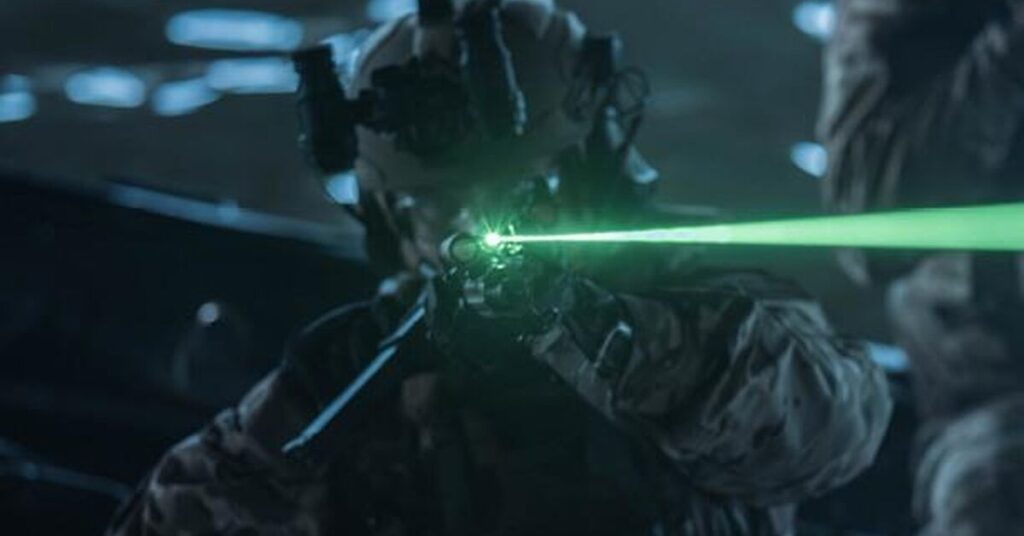
B.E. Meyers & Co. just locked in another major U.S. Army contract for its DAGIR-V1 laser system, extending a decades-long partnership that has quietly shaped how American forces own the night. Rather than another incremental upgrade, the DAGIR-V1 represents a leap in compact, high-output directed-energy capability that gives small units decisive overmatch in low-light and contested environments—exactly the kind of tool that turns “see first, shoot first” from doctrine into repeatable battlefield reality. For the 2A community this matters because every generation of military laser and illumination tech that proves itself overseas eventually migrates into the civilian market, whether through surplus channels, commercial derivatives, or the pressure it places on regulators to keep pace with what law-abiding citizens can already access in other democracies.
The deeper implication is that sustained military investment in non-lethal and intermediate-force optical systems reinforces the broader principle that technology itself is not the threat—only the intent of the user. When companies like B.E. Meyers keep pushing the envelope under strict export controls and end-user accountability, they demonstrate that advanced photonics can be responsibly fielded without creating the parade of horribles that gun-control advocates routinely predict. That track record undercuts the narrative that any new capability must be preemptively banned from civilian hands, and it keeps the Overton window open for future innovations in both the infrared and visible spectrum that private citizens will one day rely on for home defense, search-and-rescue, and low-light training.
Ultimately, this contract is another data point showing that American innovation in small-arms-adjacent technologies remains world-leading precisely because the military-industrial ecosystem is still allowed to iterate aggressively. The 2A community should watch these programs not merely for the trickle-down gear, but because they illustrate why rights-based frameworks outperform permission-slip models: when the government trusts its citizens with the same class of tools it issues to soldiers, the entire ecosystem—training, safety culture, and technical literacy—advances faster than top-down restriction ever could.


