

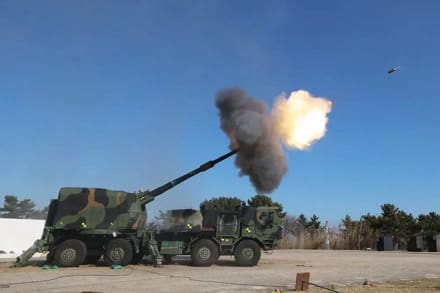
Hanwha Defense USA’s surprise win of the Army’s Mobile Tactical Cannon program is more than a procurement footnote—it’s a live demonstration that the U.S. defense-industrial base is willing to import foreign-designed, American-assembled artillery when domestic options can’t meet the schedule. The six K9MH prototypes (with an option for twelve more) will be the first 155 mm self-propelled howitzers the Army has fielded in a wheeled, shoot-and-scoot package since the Cold War. That matters to the 2A community because the same industrial muscle that can surge artillery production for the Pentagon can also surge civilian-legal firearms production when political winds shift. In other words, the K9 contract is a barometer of how quickly American factories can re-tool, and that agility is the hidden backbone of the right to keep and bear arms.
The K9 platform itself is a South Korean evolution of the M109 lineage, but with a 155 mm/52-caliber tube, an autoloader, and a top road speed above 40 mph. By choosing a proven, export-ready design over a clean-sheet U.S. program, the Army is tacitly admitting that time-to-field now outweighs not-invented-here pride. For Second Amendment advocates, the lesson is straightforward: when the government needs volume fast, it turns to the private sector—foreign or domestic—and that same private sector is the one that keeps civilian magazines, optics, and ammunition lines humming. If Hanwha can stand up a U.S. production line for howitzers, the same supply-chain logic applies to AR-15 components, suppressors, and optics mounts. The contract therefore quietly reinforces the argument that a robust, multi-caliber manufacturing ecosystem is a national-security asset, not a liability.
Finally, the MTC award lands at a moment when artillery ammunition stocks are being drawn down for Ukraine and the Indo-Pacific theater is openly discussing island-hopping campaigns that will require mobile, long-range fires. The Army’s decision to accelerate wheeled 155 mm capability is an implicit recognition that towed guns and heavy tracked systems may be too slow or too logistically cumbersome for tomorrow’s fights. That same calculus—mobility plus sustained volume of fire—mirrors the civilian debate over magazine capacity and semi-automatic rifles. A populace that can lawfully own the modern sporting rifles and optics that share the same industrial DNA as military systems is, in effect, a strategic reserve of both marksmanship and manufacturing know-how. Hanwha’s win is therefore not just an Army story; it’s a reminder that the right to bear arms and the ability to produce arms at scale are two sides of the same constitutional coin.


