

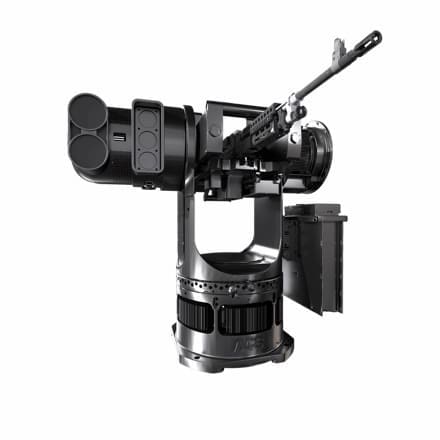
The Marine Corps’ decision to field Allen Control Systems’ Bullfrog autonomous weapon station is more than a procurement win—it’s a real-world validation that the same technologies Second Amendment advocates have long championed for personal defense are now indispensable on the battlefield. By pairing a stabilized, AI-driven turret with existing crew-served weapons, Bullfrog gives small units the ability to detect, track, and neutralize drone swarms without waiting for higher-echelon air defense. That capability mirrors the individual right to keep and bear arms: a distributed, layered defense that doesn’t rely on centralized permission or distant headquarters. In an era when hobby-grade quadcopters can be turned into precision munitions, the Corps is acknowledging that every rifle squad needs an autonomous “guardian angel” the same way every law-abiding citizen should be free to own the tools that let them protect hearth and home.
For the 2A community, the deeper implication is that the technical and legal arguments used to justify these systems in uniform apply with equal force to civilians. If the Pentagon trusts an autonomous mount to decide when to engage aerial threats in contested airspace, the notion that law-abiding Americans cannot be trusted with semi-automatic firearms or modern optics collapses under its own logic. Moreover, the supply chain that produces Bullfrog’s sensors, actuators, and fire-control software is the same ecosystem that equips competition shooters, private security teams, and responsible homeowners. As export-controlled components migrate into the commercial market, prices drop and capabilities rise—exactly the virtuous cycle the Founders envisioned when they protected the right to keep and bear arms as a check on both foreign and domestic threats.
Finally, the GBAD award underscores a cultural shift inside the military itself: the recognition that small units, not massive staffs, will win tomorrow’s fights. That same principle animates the modern self-defense movement. Just as Marines will soon carry miniaturized command-and-control in their rucksacks, American citizens increasingly rely on networked cameras, smart locks, and legally owned firearms to secure their own “perimeter.” The Bullfrog isn’t merely a counter-drone turret; it’s proof that autonomy plus marksmanship is the future of both national defense and individual liberty—and that the right to bear arms is evolving right alongside the threats it was meant to counter.


