

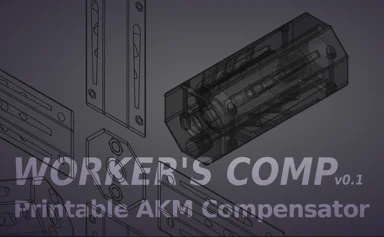
The Workers Comp v0.1 is a stark reminder that necessity remains the mother of invention in the firearms world, especially when the market fails to serve shooters priced out of premium muzzle devices. This printable compensator isn’t just a clever workaround for budget-conscious AK owners—it’s a direct challenge to the notion that effective recoil management requires expensive machined parts. The design’s use of common hardware store fasteners and a thread adapter speaks to a growing DIY ethos in the 2A community, where enthusiasts are increasingly willing to trade traditional manufacturing precision for accessibility and customization. The inclusion of a makeshift timing mechanism using an M6 screw demonstrates the kind of practical problem-solving that has defined American gun culture since its inception.
Yet this design also highlights the inherent tensions between innovation and safety that define the current landscape of 3D-printed firearms accessories. The testing protocol—requiring blast shields, incremental firing schedules, and constant inspection—reveals the experimental nature of such projects, while the documented melting after just 130 rounds underscores the material limitations that still constrain polymer-based solutions. For the broader 2A community, this represents both opportunity and responsibility: the ability to create functional muzzle devices at minimal cost expands access to recoil management technology, but it also demands a level of technical literacy and safety consciousness that not every shooter possesses. The CC-BY-SA-NC license suggests this is meant as a starting point for community iteration rather than a finished product, positioning it within the collaborative tradition that has driven firearms innovation for generations.
The implications extend beyond individual builders to the regulatory environment surrounding 3D-printed firearms components. As designs like this proliferate, they test the boundaries of what constitutes a firearm accessory versus a regulated item, while simultaneously demonstrating how distributed manufacturing can circumvent supply chain limitations and pricing structures that have historically kept certain technologies out of reach. Whether this particular design matures into something reliable enough for regular use or serves primarily as inspiration for more refined iterations, it embodies the persistent American tradition of citizens taking their firearms’ performance into their own hands—sometimes literally.


