

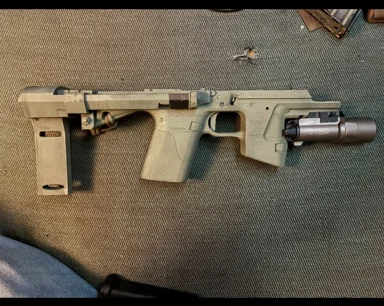
The collapsing brace represents a clever evolution in the PDW space, where builders are constantly pushing the envelope on compactness without sacrificing the core utility of a stabilizing arm. By repurposing Glock striker springs as the locking mechanism and reinforcing the assembly with trimmed 4mm threaded rods, the designer has created a solution that feels both improvised and intentional—exactly the kind of grassroots engineering that keeps the aftermarket vibrant. The fact that it’s still in beta only adds to its appeal; early adopters on platforms like the Patriot or Burner by Sumone are essentially serving as a distributed R&D team, stress-testing the concept in real-world backpack-gun scenarios where every millimeter and ounce matters.
What makes this development particularly noteworthy is how it sidesteps the regulatory minefield that has surrounded traditional braces while still delivering the ergonomic benefit shooters crave. The community has watched ATF guidance shift like sand, turning once-legal accessories into potential liabilities overnight. This DIY approach—simple, serviceable, and owner-maintained—puts control back in the hands of the end user. It’s a reminder that when the regulatory environment grows hostile, the 2A community responds not with retreat, but with ingenuity: springs scavenged from handguns, rods cut to length, and a willingness to iterate until the design is field-proven.
For the broader firearms culture, this brace is more than a gadget; it’s a statement that the spirit of customization and self-reliance remains alive even as commercial options face increasing scrutiny. Whether it ultimately matures into a widely adopted product or stays a niche solution for “extra drip” on a backpack build, its existence underscores a deeper truth: the right to keep and bear arms includes the right to innovate around them. In an era where every new rule seems designed to limit options, builders like this one are quietly expanding them—one spring-loaded click at a time.


