

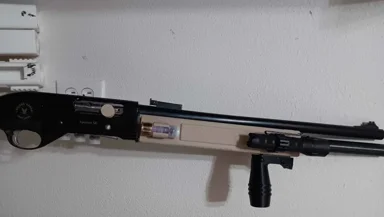
The Silver Eagle handguard project is a perfect snapshot of how the 2A community is quietly rewriting the rules of aftermarket support for imported firearms. Turkish-made shotguns have long been treated as disposable tools—cheap enough to buy, but too inconsistent for serious customization. By releasing a printable handguard that mates to the “Turk-nelli” receiver family, this maker has turned a bargain-bin scattergun into a modular platform. The fact that the design openly acknowledges fitment uncertainty is itself a statement: instead of waiting for a major manufacturer to bless the platform with official parts, users are crowdsourcing compatibility data in real time.
What stands out is the deliberate nod to open-source tooling—CNC Kitchen’s Bumpmesh texturing and a Bambu P1P printing diagonally for strength. These choices aren’t just technical footnotes; they signal that the future of firearm accessories will be driven by small-scale, highly skilled printers who treat STL files like source code. Match-saver provisions and a slip-on bolt handle that’s retained by a simple peg show how quickly garage designers can iterate features that big companies overlook or dismiss as low-margin. In effect, the handguard is less a single accessory and more a proof-of-concept that any imported shotgun can be dragged into the twenty-first century without a six-figure tooling investment.
For the broader 2A ecosystem, this matters because it lowers the barrier between “range toy” and “defensive tool.” A shooter who can print a handguard today can print an extended magwell tomorrow, and the data collected from each remix improves the next design. That virtuous cycle undercuts the legacy industry’s scarcity model and reinforces the principle that the right to keep and bear arms includes the right to repair, modify, and improve them with digital means. In a regulatory environment that often targets complete firearms rather than component files, distributed manufacturing like this becomes a quiet but durable form of resilience.


