

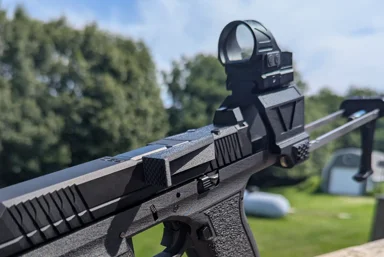
The RMR Charging Handle represents a clever evolution in chassis-based builds, where the optic’s footprint is no longer just a mounting surface but an active control interface. By integrating the charging function directly into the optic’s footprint, builders eliminate the need for a separate lever or extended knob that can snag on gear or add unnecessary mass. This isn’t merely a convenience tweak; it’s a recognition that every gram and every millimeter counts when a rifle is expected to serve as both precision tool and rapid-deployment platform. In an era where chassis systems already blur the line between traditional carbine and semi-custom precision rifle, this handle shows how small mechanical innovations can compound into meaningful handling advantages.
For the 2A community, the real story lies in the accelerating pace of decentralized design. What once required a machine shop and a six-figure budget can now be prototyped, tested, and iterated by individuals sharing files under open licenses. The RMR Charging Handle is a microcosm of that shift: a component born from community-driven CAD work that directly challenges the notion that only large manufacturers can define what a “practical” rifle looks like. As more builders adopt these kinds of hybrid interfaces, the market pressure on legacy companies grows, forcing them to either embrace modularity or watch their margins erode to garage innovators who move faster and charge less.
Beyond the hardware itself, this development underscores a broader cultural point: the right to keep and bear arms is increasingly exercised through the right to design and manufacture. Every time a new charging solution, optic mount, or chassis accessory emerges from the guncad ecosystem, it reinforces the principle that lawful citizens are not passive consumers of rights but active participants in their exercise. The RMR Charging Handle may seem like a niche accessory, yet it quietly advances the argument that technological literacy and mechanical creativity are themselves forms of Second Amendment stewardship.


