

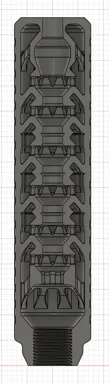
The Pill Popper V2-L 9MM remix is more than just a longer baffle stack; it’s a living case study in how the 2A community is turning open-source design into a decentralized R&D lab. By stretching the middle chambers while preserving the original’s first and last geometry, the maker is testing the classic suppressor trade-off—added volume for potential decibel reduction versus the risk of structural failure under pressure. That gamble is laid bare in the “untested, use at your own risk” disclaimer, a phrase that has become the community’s version of a terms-of-service agreement: you’re free to iterate, but you alone bear the legal and physical consequences. The 6.85-inch overall length keeps the package compact enough for pistol or SBR use, yet the extra internal real estate hints at a future where hobbyists can fine-tune sound signatures without waiting for a commercial catalog refresh.
What makes this remix culturally significant is the way it weaponizes transparency. The original Middleton Made design is referenced, not hidden, and the remix explicitly points users back to the source files and instructions. That open lineage turns every subsequent iteration into both a performance experiment and a legal stress-test of the NFA’s “one-maker, one-serial” rule set. Regulators have historically relied on scarcity of technical knowledge to enforce compliance; when a global mesh network of printers and Git-style repositories can spin up a suppressor variant overnight, that scarcity evaporates. The community’s response—crowdsourced warnings, peer pressure to follow Form 1 protocols, and public disclaimers—functions as a self-policing layer that the statute never anticipated.
For Second Amendment advocates, the Pill Popper V2-L is therefore both a technical artifact and a political signal. It demonstrates that the tooling and knowledge required for suppressor construction have already diffused beyond the regulatory perimeter, shifting the Overton window from “is it possible?” to “how do we responsibly normalize it?” Each successful, quiet range day with a printed can becomes anecdotal evidence that the NFA’s 1934 assumptions about dangerous expertise no longer match 2024 realities. The remix doesn’t just promise a few more decibels of suppression; it quietly argues that the right to keep and bear arms now includes the right to iterate on them in public, at scale, and at the speed of a shared STL file.


