

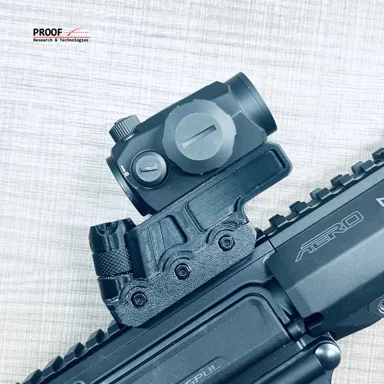
The 1.75-inch riser is more than a simple spacer; it’s a quiet rebuke to the notion that optics and irons must live in separate universes. By lifting an Aimpoint T2 or Sig Romeo 5 to a heads-up cheek-weld while preserving a true co-witness, the design acknowledges that even the most reliable red-dot can fail—whether from battery death, lens fog, or the simple chaos of a stage. The integrated HK-inspired drum sight tucked into the rear isn’t just a novelty; it’s a reminder that mechanical backups still matter, especially when the optic’s electronics go dark. In an era when many aftermarket risers force shooters to choose between height and iron utility, this single-piece solution collapses that trade-off into one 3D-printable artifact.
What makes the piece particularly resonant for the 2A community is its open-source DNA. The bill of materials is modest—nine screws and three nuts—and the print parameters are forgiving enough for a benchtop printer. That accessibility democratizes a feature set once reserved for high-end CNC’d chassis. More importantly, it invites tinkerers to iterate: swap filament for heat resistance, tweak the drum geometry for different zero distances, or scale the riser for other footprints. In doing so, the community reclaims a slice of the aftermarket that has grown increasingly proprietary and expensive.
The deeper implication is philosophical. By embedding an adjustable rear sight directly into the riser, the designer treats backup irons not as an afterthought bolted on later, but as an integral layer of redundancy. That mindset mirrors the broader 2A ethos: rights are best protected when they are exercised at multiple levels—legal, cultural, and technological. A riser that quietly insists on mechanical competence alongside electronic convenience is a small but tangible expression of that principle, one that keeps shooters both faster on target and more self-reliant when the lights go out.


