

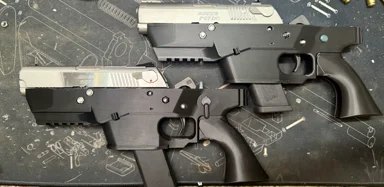
The R345 project drops like a well-timed punchline in a recession: a 3D-printed, Glock-pattern frame that mates with the slide and barrel of the long-discontinued Ruger P97 and P345 pistols, turning yesterday’s police-trade-in .45s into tomorrow’s “AARP edition” carry guns. What looks like a niche remix is actually a clever arbitrage play—Ruger’s old double-stack .45s were overbuilt, over-heavy, and under-loved once the market moved to polymer; now their orphaned parts become the donor pool for a new, lighter, and legally unserialized frame that anyone with a printer and a parts kit can finish. The beta tag signals the usual growing pains—fitment tweaks, ejector geometry, and the eternal question of whether a printed grip module can survive the stout recoil of a .45 ACP—but the very existence of the file set proves the point: legacy steel is no longer a liability when the aftermarket can re-skin it in plastic overnight.
For the 2A community this is more than a parts hack; it’s a live demonstration that regulatory pressure on new serialized firearms simply accelerates the decentralization of manufacturing. Ruger stopped making the P-series because margins and market tastes shifted, yet the installed base of slides and barrels remains in circulation; the R345 liberates that inventory from the scrap heap and puts it back into defensive service under a platform that can be iterated faster than any FFL-bound redesign cycle. It also quietly mocks the notion that banning “ghost guns” will disarm anyone—once a design is out in the open, the tooling cost collapses to the price of filament and the marginal cost of a used slide assembly. Expect the usual chorus of hand-wringing from the usual outlets, but the practical takeaway is straightforward: the more companies retire durable designs, the more the community gains a ready-made parts ecosystem that no single statute can fully interdict.
Longer term, the R345 hints at a broader pattern where yesterday’s duty guns become tomorrow’s test beds for printed ergonomics, optics cuts, and even caliber conversions that the original manufacturer never contemplated. If the beta stabilizes, we may see a cottage industry of “recession receivers” for other orphaned platforms—SIG P220 slides, S&W 59-series, even early Glocks whose frames have cracked—each one extending the service life of hardware that would otherwise be parted out or melted. That outcome doesn’t just frustrate gun-control timelines; it underscores a cultural shift in which ownership is no longer a one-time purchase but an ongoing remix project, and the Second Amendment’s protection of the means of armed self-defense now includes the means of digital manufacture itself.


