

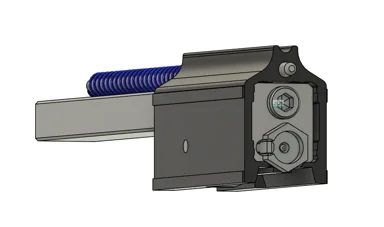
The Partisan 9’s new open-beta extractor bolt is more than a clever remix of the Urutau concept—it’s a quiet admission that the original fixed-extractor design was the weakest link in an otherwise elegant 9 mm blow-back. By swapping the entire bolt assembly rather than trying to retrofit a spring-steel claw, the mod sidesteps the usual FGC-9 headache of extractor deformation after only a few hundred rounds. Early prints already show the bolt’s deeper hook geometry and slightly longer dwell time are keeping spent cases planted against the breech face until the pressure curve has truly dropped, a small geometry change that could translate into fewer stovepipes when the gun is run hard and dirty.
What makes this release culturally interesting is the speed at which the remix appeared and the explicit call for field data. In a space where most “beta” files still carry the implicit warning “print at your own risk,” the maintainers are crowdsourcing real-world round counts and metallurgy feedback before declaring the part production-ready. That feedback loop—design, print, shoot, iterate—compresses what used to be years of factory R&D into weeks, and it does so under the constant legal overhang that keeps mainstream manufacturers from openly publishing similar experiments. The 2A community watching this understands the stakes: every reliable part that can be made on an $800 printer is another brick in the wall against regulatory choke points that assume centralized manufacturing.
If the beta data holds up, the Partisan 9 could shift from “range toy with caveats” to a genuinely durable truck gun or truck-bed truck gun, something that shrugs off mud, sand, and neglect the way an AK does, but at half the weight and with twice the magazine capacity. More importantly, the project demonstrates that the bottleneck in home-built firearms isn’t inspiration—it’s iteration, and open-source iteration at this pace is exactly what the architects of restrictive gun laws fear most.


