

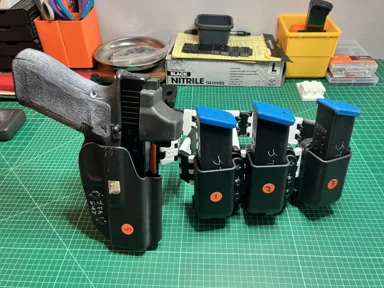
The MLGBS V5 represents something far more significant than another 3D-printed accessory—it’s a direct challenge to the notion that competition shooters must rely on expensive, proprietary gear to stay competitive. By engineering a fully modular, consumer-printable belt that meets IDPA’s strict 1.75-inch width and 5/16-inch thickness limits, the designer has effectively democratized a piece of kit that once required buying into a closed ecosystem like the DAA Lynx. The decision to use inexpensive M2 roll pins and a widely available DAA ratchet kit isn’t just cost-saving; it’s a deliberate rejection of vendor lock-in, proving that a shooter can build, repair, and resize their own belt with nothing more than a printer, a punch, and a hammer. That kind of self-reliance echoes the deeper 2A ethos: the right to keep and bear arms includes the right to maintain and customize the tools of the trade without corporate gatekeepers.
What makes this project especially compelling is how it reframes the conversation around additive manufacturing in the firearms community. Instead of chasing exotic materials or high-end printers, the V5 was optimized for everyday PETG-GF on a consumer FDM machine, with 100% infill and six-wall shells delivering competition-grade durability. The hinge redesign between V4 and V5—tighter tolerances, stronger geometry, better articulation—shows a willingness to iterate publicly and transparently, something rarely seen in commercial gear where revisions often mean forced obsolescence. By documenting every change and warning users not to mix versions, the creator has modeled the kind of open-source accountability that strengthens the entire 2A ecosystem: knowledge shared, failures admitted, improvements celebrated.
For the broader community, the MLGBS V5 is a proof-of-concept that the future of competition shooting gear may lie less in what companies sell and more in what individuals can build, test, and refine together. It lowers the barrier to entry for new competitors, reduces long-term ownership costs, and keeps critical equipment repairable at the kitchen table rather than the manufacturer’s warranty desk. In an era when supply chains and corporate priorities can shift overnight, this kind of grassroots engineering isn’t just clever—it’s a quiet act of resilience that reinforces the fundamental principle that armed citizens should also be capable citizens.


