

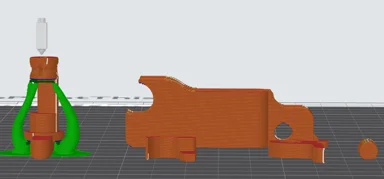
The evolution from reworked_turd to improved_turd represents more than incremental refinement—it signals a maturing mindset within the 3D-printed firearms community that prioritizes durability over novelty. Where earlier iterations treated printed forced-reset triggers as disposable experiments, this release explicitly designs for barrel-longevity, betting that advanced polymers like PPA-CF and PPS-GF 20 can outpace traditional metal components in real-world abuse. That wager carries weight: if a printed FRT can survive the same round count as a chrome-lined barrel, the economic and logistical calculus for home builders shifts dramatically, reducing reliance on scarce or regulated metal parts while still delivering repeatable forced-reset performance.
Equally telling is the packaging decision to ship a single, settings-rich 3MF file rather than a grab-bag of STLs. By embedding the exact wall counts, temperatures, and gyroid infill strategies the designer uses on their own K2 Plus, the project transforms anonymous file-sharing into a form of distributed know-how. Hobbyists no longer need to guess whether 100 % rectilinear infill will leave hidden voids; the included profile already swaps to 99 % gyroid plus Archimedean chords, boosting lever toughness by roughly 85 %. The same file also orients the notoriously fragile cross-pin horizontally, eliminating both the slow-print requirement and the mid-print topples that once scrapped entire jobs. In effect, the release converts tacit workshop knowledge into public infrastructure—an approach that accelerates collective learning curves far more effectively than scattered forum posts.
For the broader 2A ecosystem, these micro-optimizations accumulate into macro-resilience. A selector, lever limiter, and teardrop-holed housing that prints without supports all reduce points of failure that previously invited either extra machining or outright part replacement. When builders can produce an FRT whose weakest link is no longer the polymer lever or the vertical pin, the regulatory talking point that “cheap plastic toys are unsafe” loses empirical footing. More importantly, the project demonstrates that open-source firearm development is entering a phase of disciplined iteration rather than perpetual reinvention, a trajectory that strengthens the community’s ability to innovate faster than any statutory effort to keep pace.


