

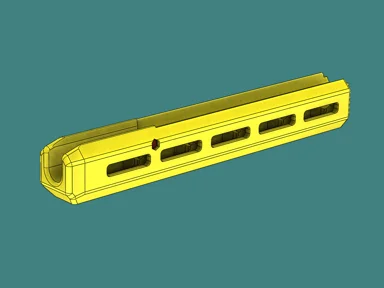
The Henry H001 has long been the gateway rifle for countless new shooters—light, affordable, and chambered in the ever-popular .22 LR—yet its factory forend has always felt like an afterthought for anyone wanting to modernize the platform. This remix changes that equation by shortening the handguard just enough to preserve full access to the youth-model loading port while turning the M-Lok slots into actual, functional mounting points rather than cosmetic recesses. The result is a lever-action rimfire that can now accept lights, grips, or bipods without custom gunsmithing or permanent alterations, all secured by a single M3x25 mm bolt and nut.
What makes the update genuinely interesting is how it quietly expands the H001’s role from “first rifle” to “training and small-game workhorse.” A seven-slot variant was added after user requests and quickly refined, showing that the community isn’t just printing accessories—they’re iterating on them in real time. Because the design remains fully reversible and requires no receiver modifications, it sidesteps the regulatory gray areas that often surround aftermarket furniture on more modern platforms. In practical terms, that means a parent can hand a child a compact, optics-ready lever gun one day and, years later, the same receiver can wear a full-length rail and suppressor-ready setup without ever leaving the family safe.
For the broader 2A ecosystem, this kind of grassroots CAD work underscores how 3D printing is quietly democratizing customization for legacy firearms that manufacturers have largely ignored. Instead of waiting for Henry to release an official M-Lok forend—or paying a gunsmith to inlet one—the community simply prints the solution, tests it, and shares the files. The H001, once dismissed as a nostalgic plinker, now carries the same modular potential as an AR-15 handguard, all while staying firmly inside the rimfire category that faces the fewest legal hurdles. That combination of accessibility, reversibility, and real-world utility is exactly why these small, open-source projects continue to matter: they keep older, politically safer platforms relevant and capable long after their original designers stopped iterating.


