

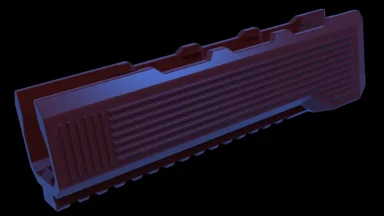
The Saiga-12 has always been the odd duck in the American shotgun market—foreign, finicky, and now effectively extinct thanks to import bans—so when a small designer like Laffs Dynamics drops a purpose-built handguard that needs nothing more than the factory retaining screw, the community takes notice. By ditching the original sling-loop hardware and replacing it with either a full-length Picatinny strip or an M-Lok interface, the new Grizzly Tracker turns a bare-bones Russian riot gun into a modular platform ready for lights, grips, or even a forward-mounted optic without milling, drilling, or custom gunsmithing. That matters because every surviving Saiga-12 is now a finite, non-renewable resource; owners who once treated the shotgun as a “set-it-and-forget-it” truck gun are suddenly looking at it as a long-term collectible worth upgrading.
What’s equally telling is the material and print spec: carbon-fiber nylon printed at five-plus wall layers and 50 % infill isn’t garage tinker territory—it’s a nod to the fact that a 12-gauge gas gun slams its furniture harder than any rifle. The decision to keep the original Russian screw also shows a quiet respect for scarcity; rather than rendering the OEM hardware obsolete, the design preserves it, letting future owners return the shotgun to stock configuration if values climb or import rules shift. In an era when polymer furniture is often disposable, this small-batch, print-at-home part quietly argues that 3-D fabrication can extend the service life of embargoed firearms instead of hastening their obsolescence.
For the broader Second-Amendment crowd, the Grizzly Tracker is a reminder that innovation doesn’t always come from big manufacturers with government contracts; sometimes it bubbles up from niche designers who simply refuse to let a capable platform die on the vine. As regulators squeeze traditional supply lines, the ability to fabricate, share, and locally produce enhancements may become as important as the firearms themselves.


