

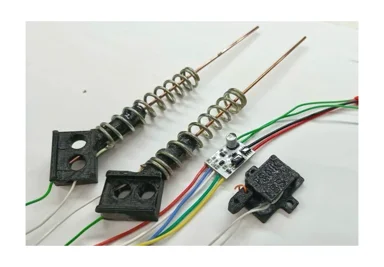
The FPV kamikaze drone community has quietly standardized on a whisker-and-microswitch arming rig that turns a simple contact probe into a reliable initiation circuit, letting the aircraft confirm physical impact before detonating its payload. What looks like a hobby-grade sensor is actually a clever mechanical fuse: spring-steel whiskers flex on contact, close a microswitch, and complete the firing train without relying on fragile electronics or GPS timing. That mechanical certainty matters when every gram counts and electronic interference is constant on the modern battlefield.
For the 2A community the lesson is straightforward: the same open-source design ethos that produced printable lowers and forced-reset triggers is now producing printable munitions components that anyone with a printer and basic electronics can replicate. The whisker mount is trivial to remix, the microswitch is off-the-shelf, and the entire assembly can be iterated faster than any export-control regime can react. That speed of adaptation is exactly why decentralized manufacturing threatens centralized arms control more than any single weapon system.
The deeper implication is that the line between “drone accessory” and “improvised munition” is now drawn in millimeters of spring steel and a few lines of G-code. Regulators who still think in terms of serial numbers and background checks will struggle to police designs that exist only as shared files and can be printed in a garage overnight. The 2A movement has long argued that rights follow technology; the FPV whisker proves the point in real time.


