

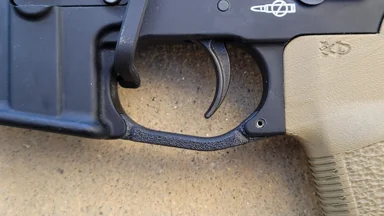
The enhanced AR15 trigger guard represents a thoughtful evolution in the ongoing quest to refine the platform’s ergonomics without compromising its core modularity. By replacing the factory stamped guard with a 3D-printed component that accepts a standard roll pin at the rear and an M3 set screw at the front, the design eliminates the need for specialized punches or roll-pin tools while still locking securely into any mil-spec lower. The choice of PET-CF at 100 % infill and five perimeter walls speaks to a deliberate balance between toughness and printability, ensuring the part can survive the same abuse as its aluminum counterpart yet remain light enough not to upset the rifle’s handling characteristics.
What makes this iteration noteworthy is how it quietly democratizes a small but meaningful upgrade. Traditional aftermarket guards often require proprietary hardware or milling; here, the only consumables are off-the-shelf roll pins and set screws that any hardware store carries. That accessibility matters in an era when supply-chain hiccups and regulatory uncertainty can make even minor components scarce. Moreover, the side-oriented print orientation and minimal support strategy reduce both material waste and post-processing time, lowering the barrier for builders who may only have a single printer and limited filament stock.
For the broader 2A community, this trigger guard is a microcosm of the larger movement toward open-source, user-serviceable firearms components. It underscores that incremental innovation—refining a single interface rather than reinventing the rifle—can still deliver tangible improvements in reliability and user agency. As more builders adopt such designs, the cumulative effect is a distributed ecosystem of parts that no single manufacturer or regulator can fully control, reinforcing the principle that the right to keep and bear arms includes the right to maintain and customize those arms with tools no more exotic than a 3D printer and a bag of hardware-store pins.


