

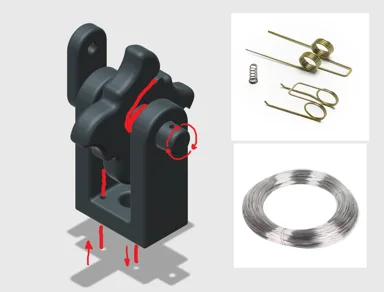
The AR-15 trigger group has always been one of the most tightly controlled pieces of the modern sporting rifle, yet a handful of 3D-printed springs now threatens to loosen that grip. By releasing printable files for the disconnector and hammer springs—complete with a simple ballpoint-pen hack for the trigger return—the maker has turned a once-proprietary component into something any hobbyist with a $200 printer can produce in an afternoon. That shift matters because springs are the heartbeat of the fire-control group; without reliable tension the safety selector, hammer, and trigger simply won’t cooperate, and until recently those tiny coils were the last link in the supply chain still dominated by a few large vendors.
For the 2A community the real story isn’t just cheaper parts—it’s the quiet erosion of centralized control. Every time a critical consumable moves from a regulated factory floor to an open-source repository, the practical effect of import restrictions, serialization schemes, or future magazine-spring bans shrinks another notch. Makers who once worried about running out of OEM springs during a panic buy can now stockpile digital files instead of physical inventory, and that redundancy is exactly what the founders had in mind when they wrote “shall not be infringed.” The files also serve as living proof that the AR platform’s modular DNA keeps rewarding those willing to tinker; what began as a military-spec rifle has become an ever-evolving ecosystem where enthusiasts—not bureaucrats—decide how many coils a spring needs.
Still, the move carries the usual caveats that accompany any home-built component: material choice, print orientation, and post-processing all affect cyclic rate and safety. Responsible builders will test-fire in controlled conditions, treat every new spring set as a prototype, and remember that rights also imply duties. Yet the larger implication is unmistakable—once the knowledge and tooling live in the wild, attempts to gate-keep the AR-15’s most fundamental moving parts become exercises in nostalgia rather than policy.


