

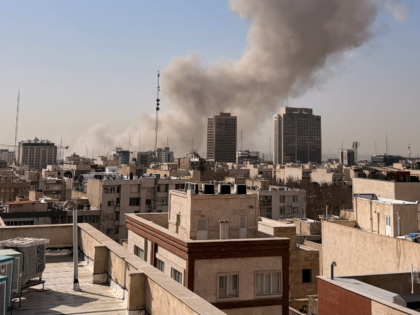
The U.S. decision to expand strikes across Iran—taking out air-defense radars, command nodes, and bases from the Persian Gulf to the Caspian—signals a deliberate campaign to strip away Tehran’s ability to contest its own airspace. That matters to the 2A community because every successful suppression of enemy air defenses lowers the perceived cost of future American intervention, and the same logic applies at home: when a government demonstrates it can neutralize sophisticated, integrated air-defense networks in days, citizens are reminded why an armed populace remains the ultimate backstop against centralized overreach. The optics of precision munitions cratering S-300 batteries and hardened aircraft shelters also underscore how quickly modern states can degrade an adversary’s conventional deterrent, a lesson not lost on those who argue that an armed citizenry is the only reliable hedge once the lights go out on institutional power.
At the same time, the inclusion of targets near a nuclear-power complex raises the stakes for proliferation watchers and firearms owners alike. If Washington is willing to risk escalation to keep fissile material out of the hands of a theocratic regime, it reinforces the principle that some threats are existential enough to justify pre-emptive force—an argument that parallels domestic debates over whether certain individuals or groups should be preemptively disarmed. The strikes also highlight the continuing relevance of small arms and crew-served weapons in the aftermath of high-end strikes; once the air-defense grid collapses, infantry weapons and decentralized militias become the decisive factor on the ground, exactly the scenario 2A advocates cite when they warn against ceding a monopoly on force to the state.
Finally, the rapid tempo of these operations serves as a real-time case study in how quickly supply chains, logistics nodes, and even civilian morale can be reshaped by the removal of a few critical systems. For gun owners, that translates into renewed urgency around stockpiling, training, and community networks—because the same vulnerabilities that let cruise missiles silence radar sites can just as easily disrupt commercial ammunition flows or local law-enforcement capacity if conflict widens. In short, the widening campaign against Iran is not merely a foreign-policy story; it is a live demonstration that technological superiority and centralized control are brittle, and that distributed, armed resilience at the individual level remains the most durable form of deterrence.


