

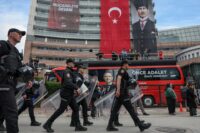
Turkish police storming the offices of the main opposition CHP party with tear gas and rubber bullets isn’t just another headline from a distant capital—it’s a textbook demonstration of what happens when a government decides the only acceptable form of political participation is the one it controls. In a country where civilian firearms ownership is already heavily restricted and effectively limited to a narrow class of licensed hunters and sport shooters, the state retains a near-monopoly on force. When that same state turns its non-lethal munitions on opposition headquarters, it sends an unmistakable message: dissent will be met with state hardware, and the citizenry has no comparable tools to push back. For Americans who still view the Second Amendment as the ultimate check against authoritarian overreach, scenes like this serve as a live-action reminder that rights on paper mean little if the population has been systematically disarmed.
The deeper implication is how quickly “public safety” rhetoric can be repurposed to neutralize political competition. Turkey’s ruling apparatus has long justified strict gun control by citing terrorism and street crime; now those same laws leave opposition figures exposed when the security services decide to clear their offices. Rubber bullets and tear gas are sold to the public as humane alternatives, yet they still allow authorities to physically dominate spaces and people without immediate lethal consequences—something far harder to accomplish if citizens retained a credible armed deterrent. The CHP raid therefore isn’t an isolated policing action; it’s the predictable endpoint of a decade-long project that paired civilian disarmament with the consolidation of state power.
For the U.S. 2A community, the lesson is straightforward: every new restriction on lawful ownership, every fresh “assault weapon” ban or magazine limit, incrementally recreates the imbalance now on display in Ankara. Once the government alone decides who may possess effective means of resistance, the definition of “resistance” itself becomes whatever the government says it is. Turkey’s opposition didn’t lose its offices because it lacked votes; it lost them because it lacked parity in force. That asymmetry is exactly what the American founders sought to prevent, and exactly what modern gun-control advocates are working to recreate—one regulation at a time.


