

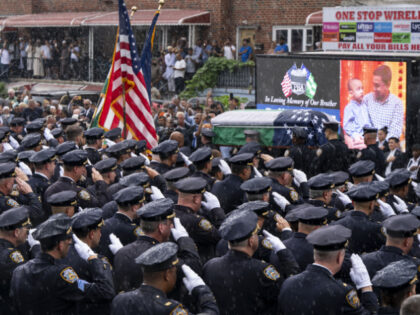
President Trump’s move to mandate capital punishment for cop killers lands at a moment when law-enforcement fatalities are already at an 80-year low, a fact that undercuts the usual “epidemic of violence” narrative yet still underscores a deeper principle: the state’s monopoly on legitimate force must be absolute if citizens are to retain the right to defend themselves. By elevating the penalty for murdering officers, the administration is reinforcing the same hierarchy of rights that underpins the Second Amendment—namely, that the individual’s right to life and liberty is non-negotiable and that government agents sworn to protect those rights deserve the strongest deterrent the law can offer. For the 2A community, the message is clear: when the government treats attacks on its own enforcers with maximum seriousness, it implicitly validates the individual’s parallel right to meet force with force when the state cannot or will not intervene.
The timing also matters. With violent crime statistics trending downward in many jurisdictions, the executive order functions less as a reaction to a crisis and more as a philosophical stake in the ground. It signals that the rule of law is not a social construct to be negotiated but a precondition for ordered liberty—the very condition that allows law-abiding citizens to exercise their right to keep and bear arms without descending into vigilantism. Gun owners who have watched progressive cities decriminalize offenses against police will see this order as a necessary counterweight, one that preserves the moral distinction between the armed citizen and the criminal predator.
Critics will claim the policy is symbolic, yet symbolism in criminal justice often shapes culture faster than statutes. By making cop-killing a capital offense nationwide, the administration is reminding the public that some acts cross a bright line no amount of “context” can erase. That clarity benefits the 2A community by reinforcing the idea that rights and responsibilities are reciprocal: if society demands that officers place their lives on the line, it must also affirm that those who deliberately extinguish those lives forfeit their own. In an era when the right to self-defense is under constant legal and cultural pressure, such affirmations are not peripheral—they are foundational.


