

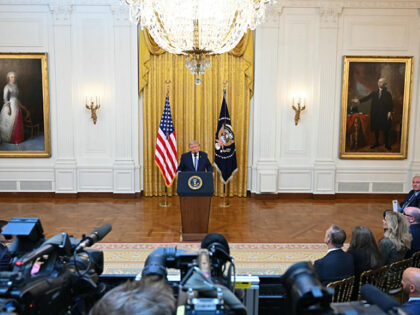
President Trump’s pointed rebuke of NBC and ABC for ignoring his election-integrity address lands like a warning shot across the bow of legacy media, and the 2A community should treat it as such. When the networks that once styled themselves as neutral arbiters now reflexively shield one political faction from scrutiny, they reveal the same institutional bias that fuels every push for magazine bans, red-flag laws, and ATF rule-by-letter. The President’s findings—documented irregularities, chain-of-custody failures, and statistical anomalies—aren’t abstract political theater; they’re the predicate for the same “trust us, citizen” logic that gun-control advocates deploy whenever they demand we surrender due-process rights in the name of public safety. If the press can memory-hole questions about ballot harvesting and unsecured drop boxes, it can just as easily memory-hole the next bump-stock ban or pistol-brace reclassification.
The deeper implication is structural: an information gatekeeper class that refuses to air evidence of electoral vulnerability is the same class that insists only the government can be trusted with firearms. Every time a major outlet spikes a story that might embarrass the administrative state, it reinforces the narrative that dissent itself is dangerous—an argument already weaponized against gun owners through social-media deplatforming, financial surveillance of ammunition purchases, and “ghost gun” rulemaking. Trump’s speech, whether one agrees with every detail, underscores why the Second Amendment remains the ultimate check on institutional overreach; without a credible electoral process, the people’s ability to course-correct through the ballot box erodes, leaving only the cartridge box as the final backstop the Founders envisioned.
For pro-2A citizens, the takeaway is straightforward: media silence on election integrity is not a partisan inconvenience but a strategic signal that the same forces eager to disarm law-abiding Americans are equally eager to control what information reaches them. The networks’ blackout isn’t about ratings; it’s about narrative preservation. And when the story they refuse to tell concerns the very mechanism that selects the officials who write gun policy, the stakes for every gun owner become unmistakably clear.


