

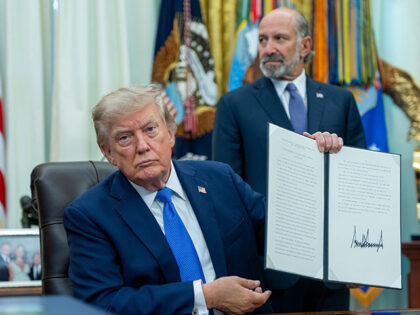
President Trump’s move to curb birth tourism and tighten birthright citizenship isn’t just an immigration story—it’s a direct shot across the bow of the administrative state that has long treated the Fourteenth Amendment like a blank check. By reasserting that mere presence on U.S. soil doesn’t automatically confer citizenship, the orders force a long-overdue conversation about what “subject to the jurisdiction thereof” actually means. For the Second Amendment community, that conversation matters because every new citizen is another voter who will eventually decide whether the right to keep and bear arms remains a fundamental liberty or becomes a heavily regulated privilege. When the definition of “American” is tightened, the electorate that ultimately ratifies or rejects gun-control referenda, judicial nominees, and ATF rules shifts with it.
The practical effect is already rippling through sanctuary jurisdictions that have counted on automatic citizenship to pad future census numbers and, by extension, Electoral College votes and House seats. Those extra representatives often come from districts where gun ownership is treated as a public-health crisis rather than a constitutional right. By slowing the pipeline of future voters whose first political memory is a government form rather than a family tradition of marksmanship or hunting, the policy quietly strengthens the coalition that still believes the Bill of Rights is a package deal. It also undercuts the narrative—pushed hard in recent ATF rulemakings—that demographic destiny makes stricter gun laws inevitable. In short, the same legal theory that limits birthright citizenship can be turned against other novel interpretations of constitutional text, including the notion that “the people” in the Second Amendment somehow excludes law-abiding citizens who weren’t born here.
Gun owners who have watched decades of incremental restrictions justified by “changing demographics” now have a concrete example of how sovereignty can be reasserted without waiting for Congress. The lesson is portable: if the executive branch can narrow the aperture through which new voters enter the polity, it can also narrow the aperture through which new restrictions on arms enter the regulatory code. That symmetry is why the usual critics are already warning that the orders “radicalize” constitutional interpretation; they understand that once the living-document crowd loses automatic demographic tailwinds, the original meaning of the Second Amendment becomes far harder to evade.


