

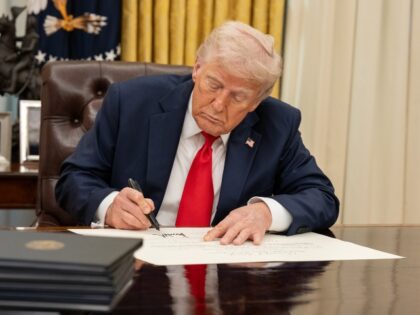
President Trump’s move to require AI developers to run their newest models past federal reviewers before launch is being sold as a safety measure, but the real story is about who ends up holding the kill switch on information. The order creates a 30-day pre-release window during which companies must hand over technical details, training data summaries, and risk assessments. While the language is framed around “national security” and “misinformation,” the same infrastructure that can flag an algorithm for generating “dangerous” chemical recipes can just as easily be pointed at speech that questions election integrity, medical mandates, or—most relevant to us—the Second Amendment itself. Once the review pipeline exists, expanding its mission from “AI safety” to “content safety” is a matter of bureaucratic momentum rather than new legislation.
For the 2A community the stakes are immediate and practical. AI models are already being used to scrape social-media posts, analyze firearm-related imagery, and generate watch lists that blend lawful gun owners with suspected extremists. A government-vetted model could quietly bake in new definitions of “high-risk” behavior—owning standard-capacity magazines, frequenting ranges, or even searching for parts kits—then feed those flags to agencies that already treat the gun culture as a threat vector. Because the review is “voluntary,” companies eager for federal contracts or regulatory goodwill will likely comply; once the biggest players adopt the standard, smaller ones will follow to stay competitive. The result is a de-facto prior-restraint regime on digital tools that millions of Americans rely on for research, training, and organizing.
The deeper implication is that the same executive authority now being cheered by some on the right could be wielded by a future administration with very different priors. If the precedent stands, the next occupant of the Oval Office need only re-interpret “safety” to include “reducing gun violence” and suddenly every open-source large-language model becomes subject to pre-publication censorship. That is why this order deserves more scrutiny than a press-release victory lap: it hands the administrative state a new dial for controlling speech, and the 2A community has every reason to assume that dial will eventually be turned in our direction.


