

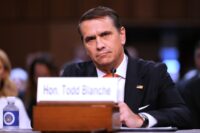
President Trump’s threat to yank Matthew Blanche’s nomination for attorney general until every dissenting senator is out of office is more than a personnel drama—it’s a calculated shot across the bow of the Senate’s institutional resistance to a hard-charging Second Amendment agenda. Blanche, a former federal prosecutor with a record of defending gun owners in high-profile cases, was already viewed by the gun-rights community as a rare find: someone who understands both the courtroom and the culture war over the right to keep and bear arms. By tying his confirmation to the electoral fortunes of the very senators who have slow-walked pro-2A judges and blocked suppressor deregulation, Trump is signaling that the old “go along to get along” era is over and that the Senate’s internal calendar will no longer dictate the pace of restoring constitutional carry nationwide.
The move also reframes the 2026 midterms as a referendum on gun policy rather than a generic partisan contest. If Trump follows through, every Republican primary challenger will be able to run against an incumbent’s vote on Blanche, turning what might have been a sleepy confirmation fight into a live-fire loyalty test. Gun owners, already mobilized by recent ATF rules on pistol braces and proposed restrictions on 80 percent receivers, now have a tangible benchmark: support the nominee or face a well-funded primary backed by both the White House and the grassroots. That kind of explicit linkage between elections and appointments has rarely been applied to the gun issue; if it works, it could accelerate the retirement of the handful of GOP senators who still treat the NRA scorecard as optional reading.
Longer term, the episode underscores a strategic shift inside the broader constitutional-carry coalition: instead of lobbying for incremental legislation that can be bottled up in committee, the movement is now focused on capturing the personnel machinery that interprets and enforces the law. A Blanche-led Justice Department would not merely defend shall-issue permitting in the courts; it could also revisit the Trump-era proposal to remove suppressors from the National Firearms Act and revisit the Obama-era “zero tolerance” revocation policy that shuttered FFLs over paperwork technicalities. By making Blanche’s confirmation the hill on which recalcitrant senators may fall, Trump has converted an attorney-general nomination into a forcing mechanism for the next phase of the gun-rights fight—one that will be waged as much in Senate cloakrooms as on the range.


