

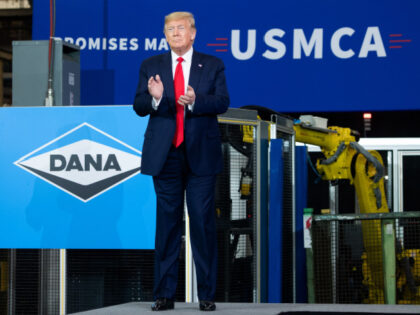
President Trump’s suggestion that he might let the USMCA expire is more than a trade headline—it’s a signal that the same “America First” logic he applied to renegotiating NAFTA is back on the table. The original deal was sold as a fix for the lopsided deficits that have drained U.S. manufacturing for decades, yet the numbers show we still run an annual goods deficit of roughly $70 billion with Mexico and another $30-plus billion with Canada. If Trump follows through, negotiators would almost certainly reopen chapters on rules-of-origin, dairy, and automotive content—the very provisions that determine whether a Canadian-made firearm part or a Mexican-machined optic counts as “American” under federal sourcing rules. For the domestic gun industry, that matters: every extra percentage point of North-American content required to avoid tariffs is another incentive for companies to keep milling, forging, and finishing inside the United States instead of chasing cheaper labor south of the border.
The 2A angle sharpens when you consider how trade policy intersects with regulatory pressure. A tighter USMCA could slow the flood of imported frames, slides, and budget optics that compete with U.S.-made equivalents, giving American manufacturers breathing room at a moment when ATF rules on pistol braces, solvent traps, and “ghost-gun” kits are already reshaping the market. Conversely, if Canada or Mexico retaliate with duties on U.S. firearms and ammunition exports, companies that rely on those markets—think Smith & Wesson’s Canadian law-enforcement contracts or Federal’s shotshell shipments—could feel the pinch. Either way, the debate forces a conversation the gun community rarely has out loud: how much of our supply chain sovereignty are we willing to trade for marginally lower sticker prices on imported widgets?
Bottom line, Trump’s trial balloon is a reminder that trade deals are national-security tools as much as economic ones. A renewed push for balanced North-American commerce could strengthen the industrial base that produces everything from match-grade barrels to night-vision housings, while also exposing how dependent we’ve become on foreign vendors for critical components. For Second Amendment advocates who view an armed citizenry as inseparable from a capable domestic manufacturing sector, the next round of USMCA talks is worth watching as closely as any ATF rulemaking.


