

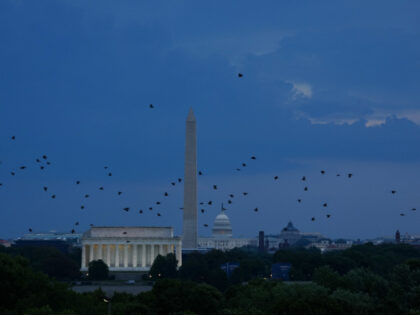
President Trump’s decision to push the Salute to America celebration back to an 11 p.m. keynote after weather forced an earlier evacuation is more than a scheduling footnote—it’s a deliberate signal that the nation’s birthday will not be dictated by the elements or by critics who would prefer a subdued commemoration. By reopening the National Mall at 9:45 p.m. and insisting the address go forward, the administration is framing July 4th as an unapologetic assertion of American resilience, complete with the very military hardware and flyovers that have become flashpoints in the culture war over national pride. For the 2A community, the optics matter: the same president who restored “Salute to America” after years of scaled-back events is once again coupling patriotic pageantry with visible displays of American power, reinforcing the idea that a strong national defense and an armed citizenry are two sides of the same coin.
The late hour also carries a tactical undertone. Holding the speech at 11 p.m. guarantees prime-time cable coverage deep into the evening, ensuring that images of tanks, jets, and uniformed personnel reach the widest possible audience at a moment when progressive cities are still debating whether to even hold fireworks. That extended spotlight keeps the conversation centered on strength and sovereignty rather than on the usual calls for gun restrictions that often follow high-profile public events. In an election cycle where Democrats continue to push magazine bans, red-flag expansions, and restrictions on private sales, the visual of a commander-in-chief celebrating the military on the National Mall serves as a counter-narrative that links constitutional carry and individual preparedness with the broader defense of the republic.
Ultimately, the rescheduled address underscores a deeper philosophical divide: one side views America’s founding principles—including the Second Amendment—as living traditions worth displaying; the other treats them as relics to be managed or minimized. By refusing to cancel or censor the celebration, Trump is giving the firearms community and its allies another data point that elections have consequences for both culture and policy. The 250th birthday, now set to be toasted well past sunset, becomes less about nostalgia and more about a forward-looking affirmation that the right to keep and bear arms remains central to the American experiment.


