

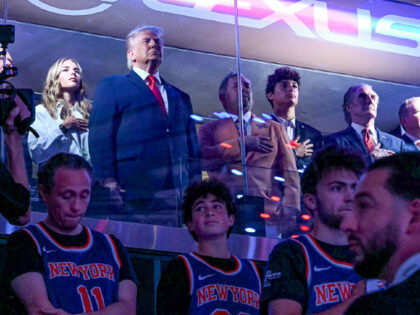
Donald Trump’s surprise courtside appearance at Madison Square Garden didn’t just deliver the highest NBA Finals Game 3 rating since 1998—it spotlighted how a pro-Second Amendment commander-in-chief can turn even a basketball arena into a referendum on constitutional rights. By showing up in a city that has spent decades tightening its already draconian gun laws, the president reminded viewers that the same federal government now led by a shall-issue champion is also the one that can push back against local edicts treating lawful carry as a public menace. The ratings spike wasn’t merely about nostalgia for the Knicks; it was about millions of sports fans who rarely tune into policy suddenly seeing a president who treats the Second Amendment as non-negotiable rather than a bargaining chip.
For the 2A community the optics matter as much as the legislation. Every time Trump appears in a high-profile, gun-restricted venue without the usual media freak-out over his security detail’s plainly visible firearms, it normalizes the idea that armed protection and ordinary citizens exercising their rights are two sides of the same coin. That normalization travels beyond Manhattan: it undercuts the narrative that “assault weapons” or “high-capacity magazines” are too dangerous for civilian hands when the president’s own detail carries far more potent hardware without apology. Meanwhile, the Spurs-Knicks matchup itself became a living contrast—New York’s discretionary permitting regime versus Texas’s constitutional carry—giving casual viewers an inadvertent lesson in which jurisdictions trust their citizens and which ones treat them as perpetual suspects.
The larger implication is that cultural reach amplifies policy wins. When a single presidential appearance can goose two-decade-old viewership numbers, it proves the 2A message travels best when it’s embedded in mainstream entertainment rather than confined to policy white papers. Expect future administrations—whether friendly or hostile—to notice that a president who unapologetically supports the right to keep and bear arms can also dominate the cultural conversation, turning every public outing into both a security statement and a subtle recruiting tool for the next generation of gun owners.


