

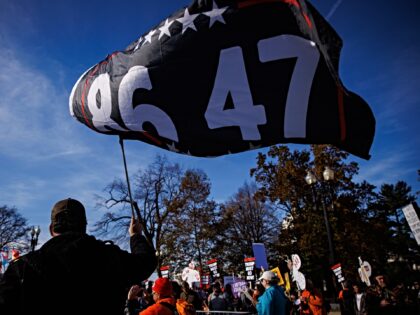
In a ruling that should raise eyebrows far beyond the Beltway, a federal judge just told the National Park Service it cannot yank a protest permit simply because demonstrators are waving an “86 47” flag—an unmistakable call to “eliminate” the 47th president. The decision frames the slogan as protected political speech, but the optics are impossible to ignore: an explicit threat against a sitting chief executive is being treated as just another viewpoint in the marketplace of ideas. For the firearms community, the message is clear—when the administrative state is told it must accommodate rhetoric that literally advocates removing a president by any means necessary, the same logic will be weaponized against law-abiding gun owners whose only “threat” is a Gadsden flag or an NRA sticker on a pickup truck.
The deeper problem is selective tolerance. Progressive protest culture has normalized eliminationist language—“punch a Nazi,” “direct action,” “by any means”—while the administrative apparatus looks the other way or actively enables it. Meanwhile, a single open-carry demonstration or a range-day photo on social media can trigger multi-agency investigations, no-fly listings, or quiet referrals to financial-crime units. If courts are now declaring that “86 47” is sacrosanct expression, the 2A community must ask why a constitutionally enumerated right is subjected to far stricter scrutiny than open calls for political violence. The asymmetry is not an accident; it is the predictable result of an institutional culture that views the right to keep and bear arms as inherently suspect.
The practical takeaway is that legal and cultural self-defense has never been more important. Groups that track permitting fights, campus speech codes, and corporate deplatforming already know the pattern: today it is a flag in D.C., tomorrow it is a standard-capacity magazine ban justified by the same “public safety” rationale that somehow did not apply to eliminationist protest signage. The 2A community cannot rely on the administrative state or the courts to apply neutral principles; it must continue building parallel institutions, state-level sanctuaries, and rapid-response legal networks that treat every regulatory squeeze as part of the same long game.


