

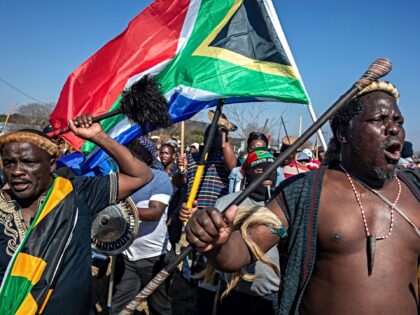
South Africa’s major cities grinding to a halt ahead of anti-migrant demonstrations is more than a local labor story—it’s a textbook case of what happens when a government loses the monopoly on legitimate force and citizens are left to improvise their own security. With shops, offices, and public spaces voluntarily shuttered, ordinary South Africans are signaling that they no longer trust the state to keep the peace, a dynamic that echoes the conditions that gave rise to America’s armed-citizen tradition. The 2A community should read this as a live demonstration of the principle that rights without the practical means to defend them are little more than polite suggestions; when police are stretched thin or politically constrained, the difference between a quiet neighborhood and a looted one often comes down to who showed up with rifles the night before.
The deeper implication is that migration policy failures and disarmament policies travel together. South Africa’s post-apartheid gun-control regime has steadily tightened civilian access to firearms while simultaneously failing to secure its borders or integrate millions of economic migrants. The result is a powder keg in which both native and newcomer populations feel existentially threatened, yet only those who retained or acquired arms outside the law enjoy any real agency. For American gun owners watching the footage of shuttered Johannesburg storefronts, the lesson is unmistakable: an armed populace is the ultimate backstop against both state collapse and the chaos that follows when large, unvetted populations collide with an unarmed host society.
Finally, the economic self-censorship on display—businesses closing preemptively—illustrates how quickly civil society withers when people cannot lawfully project force in their own defense. In the United States, the Second Amendment continues to underwrite a culture in which millions of citizens can still deter predation without waiting for slow or indifferent police response. South Africa’s looming unrest should serve as a cautionary export: erode that right, import incompatible populations at scale, and the same calculus that forced South African shopkeepers to board their windows will eventually confront American neighborhoods that once believed “it can’t happen here.”


