

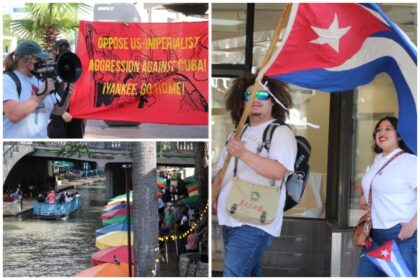
In the shadow of the Alamo, a handful of self-described socialists and “Right to Rebel” activists waved Cuban flags and handed out Marxist pamphlets just steps from the Riverwalk, timing their demonstration to coincide with the run-up to America’s 250th birthday. Their chants praising the Castro regime’s “achievements” landed with particular irony in a city whose very name evokes the fight for independence from centralized, authoritarian rule. While the turnout was small, the optics were unmistakable: a public celebration of a one-party state that has spent six decades stripping its citizens of the right to keep and bear arms, all while America prepares to mark a quarter-millennium of constitutional liberty.
For the 2A community, the episode is a timely reminder that anti-gun ideology rarely travels alone. Cuba’s 1959 revolution was followed almost immediately by the confiscation of privately held firearms, a move justified in the name of “public safety” that left ordinary Cubans defenseless against both state repression and criminal predation. The same pattern has repeated wherever Marxist-Leninist movements have seized power, from Nicaragua to Venezuela, where gun bans served as the gateway to broader disarmament and control. When activists in San Antonio openly romanticize that model, they are not merely expressing foreign-policy dissent; they are signaling comfort with a political philosophy that treats the armed citizen as an existential threat.
The contrast could not be sharper as the nation approaches its semiquincentennial. July 4, 2026, will commemorate a founding document that explicitly recognized the right of the people to keep and bear arms as a safeguard against tyranny—the very safeguard Cuba’s rulers have spent generations denying their subjects. Every time a fringe group publicly cheers that denial, it underscores why vigilance remains essential: the same arguments once used to disarm Cubans are recycled today in American cities and statehouses. The 2A community’s task is straightforward—keep reminding fellow citizens that the freedom to own firearms is not a cultural preference but the practical guarantor that no future “revolutionary” minority can impose its vision by force.


