

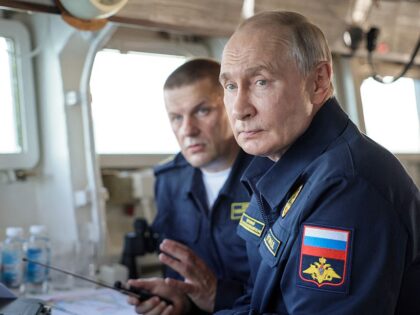
The Kremlin’s latest saber-rattling over “shadow fleet” tankers is more than a maritime spat—it’s a reminder that energy, sanctions, and naval power are now fused into a single battlefield. When Putin promises to board British and French vessels in retaliation, he is betting that Western navies will hesitate to escalate while their own merchant hulls are at risk. That calculation hinges on the same asymmetry the 2A community has long understood: a determined actor with limited assets can still impose outsized costs if the other side is unwilling to match resolve with force. The parallel to domestic gun-control debates is obvious; an armed citizenry raises the price of aggression, whether the aggressor is a street criminal or a state actor testing red lines at sea.
For American gun owners, the episode underscores why the Second Amendment is not an isolated civil-liberty issue but a strategic hedge against any form of coercion that relies on helplessness. Europe’s energy dependence on Russian crude has already forced NATO capitals to weigh economic pain against military risk; an unarmed populace would face the same dilemma on a national scale if supply chains were ever held hostage. Meanwhile, the U.S. Navy’s renewed focus on convoy protection and commerce raiding drills quietly validates the Framers’ assumption that free navigation of the seas—and the commerce that rides them—requires credible, distributed firepower. In short, the same principle that keeps a homeowner’s rifle relevant keeps a nation’s carrier groups relevant: deterrence works best when the cost of trespass is unpredictable and potentially lethal.
The larger implication is that sanctions, like gun-control laws, are only as strong as the willingness to enforce them with something harder than paperwork. If Russian tankers keep sailing under flags of convenience and European navies keep looking the other way, the precedent will encourage other revisionist powers to treat maritime interdiction as a low-risk game. Conversely, a robust, rules-based order backed by both hard power and legal clarity is the maritime equivalent of constitutional carry: it raises the bar for bad actors without requiring constant intervention. The 2A community has made that argument on land for generations; the latest Baltic drama shows it applies just as forcefully at sea.


