

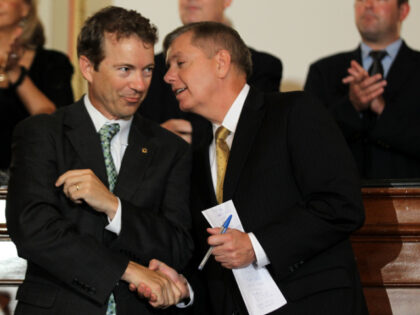
In a surprising twist that has Washington insiders buzzing, Senators Lindsey Graham and Rand Paul—two voices rarely in lockstep—have thrown their weight behind President Trump’s new Memorandum of Understanding with Iran. The agreement, which reportedly includes verifiable limits on Tehran’s nuclear enrichment and opens channels for monitored conventional-arms purchases, marks a pragmatic pivot from the maximum-pressure campaign of Trump’s first term. Graham, long a hawk on Tehran, appears to have been swayed by the inclusion of strict end-use monitoring on any weapons transfers, while Paul’s libertarian skepticism of endless foreign entanglements found common ground in the deal’s emphasis on verifiable compliance over open-ended sanctions. For the firearms community, the real story lies in the fine print: the MOU explicitly carves out a pathway for U.S. manufacturers to export certain non-automatic sporting arms and optics under the same inspection regime applied to other conventional systems, a concession that could reopen a market once thought permanently closed.
The political optics are equally telling. By securing bipartisan Republican cover, Trump has insulated the deal from the kind of reflexive partisan sabotage that sank the original JCPOA, signaling that even traditional foreign-policy hawks now view calibrated engagement as preferable to perpetual confrontation. That matters for Second Amendment advocates because any expansion of lawful U.S. exports strengthens the domestic industrial base—more overseas sales mean higher volume, lower per-unit costs, and sustained R&D budgets that ultimately benefit American shooters through better rifles, ammunition, and accessories. Conversely, if the monitoring regime proves porous, the same channels that move sporting arms could be exploited to funnel components to Iranian proxies, a risk the ATF and State Department will have to police with unprecedented rigor.
Longer term, the Graham-Paul alignment hints at a broader realignment inside the GOP: a willingness to trade limited, verifiable concessions for strategic stability rather than chasing regime change on the installment plan. For the 2A community, that translates into a narrower but more durable window to advocate for export-friendly policies that treat civilian firearms as legitimate articles of commerce rather than diplomatic bargaining chips. If the MOU holds, expect renewed pressure on the administration to codify those carve-outs in regulation, giving manufacturers and importers clearer rules and giving American gun owners indirect but tangible benefits from a deal most never expected to see.


