

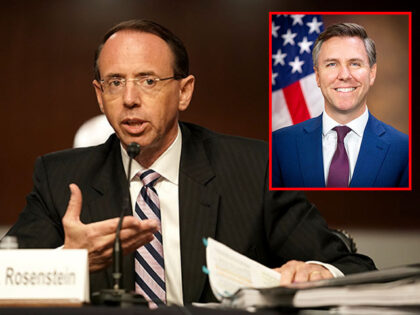
Brett Shumate’s reported push to keep the federal government in the suppressor-registration business is more than a procedural squabble—it’s a window into how career lawyers inside the Justice Department treat the Second Amendment as a regulatory nuisance rather than a constitutional command. By urging an appeal of a district-court ruling that would have ended the decades-old requirement to register suppressors, Shumate is effectively arguing that the NFA’s 1934-era paperwork regime must survive even when the underlying statute no longer commands it. That stance is especially striking given the Biden-Harris administration’s broader pattern of stretching old statutes to reach new restrictions on lawful gun owners.
The irony is sharpened by the political provenance of Shumate’s nomination. Former Deputy Attorney General Rod Rosenstein—the same official who signed off on the Carter Page FISA warrants and later defended the Mueller probe—publicly vouched for Shumate’s confirmation. Rosenstein’s endorsement signals that the institutional reflexes forged during the Russia-collusion years remain alive inside DOJ’s Civil Division, where the instinct to preserve bureaucratic power often outweighs any fresh scrutiny of whether a given regulation still serves a legitimate public-safety purpose. For the 2A community, the episode is a reminder that personnel choices below the political-appointee level can quietly lock in decades-old gun-control architecture long after the political winds have shifted.
If the appeal proceeds, the case will test whether courts are willing to let agencies keep citizens on a federal registry simply because the paperwork has always existed. A loss for the government would not only lift an unnecessary compliance burden on suppressor owners; it would also send a signal that the administrative state cannot indefinitely perpetuate regulatory regimes whose original rationale has evaporated. Conversely, a win for DOJ would entrench the precedent that once a firearm accessory is swept into the NFA, it stays there regardless of technological change or evolving constitutional doctrine—an outcome that would chill future challenges to other legacy gun restrictions.


