

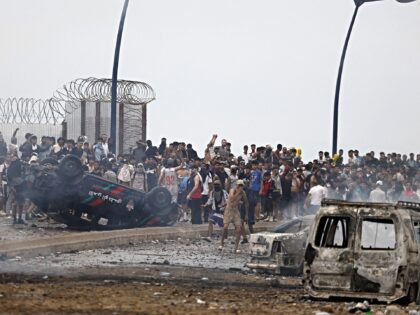
Morocco’s finger-pointing at “criminal trafficking networks” is a textbook deflection that ignores the deeper policy failures driving the Ceuta surge. By framing the crisis as the work of shadowy cartels, Rabat sidesteps its own role in allowing porous borders and lax enforcement that let thousands of migrants mass at the Spanish fence. The real story is a familiar one: when governments refuse to secure their frontiers, opportunistic networks fill the vacuum, turning human desperation into a profitable commodity. For the 2A community, the lesson is unmistakable—disarmed or under-armed populations become easy prey for the same predators who exploit open borders, whether those predators are smugglers moving people or cartels moving drugs and weapons.
The Ceuta episode also underscores how quickly a migration flashpoint can metastasize into a broader security threat. Spanish authorities have already reported firearms and edged weapons among the arriving crowds, a reminder that traffickers rarely limit themselves to one illicit cargo. When the same networks that ferry migrants can pivot to smuggling handguns, rifles, or the components for homemade firearms, the Second Amendment’s individual-right foundation becomes not just a constitutional principle but a practical necessity. Law-abiding citizens on either side of the Strait—or on either side of the Rio Grande—cannot outsource their safety to governments that prioritize optics over enforcement.
Finally, the optics war itself is instructive. By blaming “criminal organizations,” Morocco hopes to shift Western media focus from its own governance shortcomings to an amorphous enemy that conveniently justifies further crackdowns on legal gun ownership and self-defense rights. The 2A community should recognize this rhetorical sleight-of-hand: every time a border crisis is pinned on “criminals with guns,” the next policy proposal is almost always aimed at disarming the law-abiding rather than hardening the border. The Ceuta flood is therefore more than a migration story; it is a live-fire demonstration of why an armed citizenry remains the ultimate backstop when state capacity falters.


