

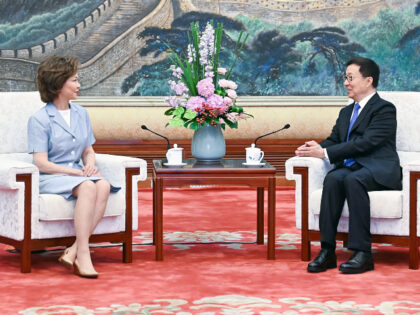
Elaine Chao’s lightning trip to Beijing just days after Mitch McConnell’s medical scare is more than a family footnote—it’s a reminder that the same political class shaping U.S.-China policy also controls the levers that decide whether American gun owners keep their rights. While McConnell lay in a hospital bed, his wife was shaking hands with Beijing’s number-two official, a regime that has spent the last decade tightening its own domestic gun bans while simultaneously flooding American streets with fentanyl precursors and ghost-gun components. The optics are jarring: one half of the couple is literally tied to life-support machines, the other is still jetting off to the capital of America’s chief strategic rival, underscoring how personal and policy entanglements with China run straight through the heart of the Republican establishment.
For the 2A community the stakes are concrete. Every time Washington’s attention drifts toward managing relations with a hostile power, domestic priorities like protecting the right to keep and bear arms get pushed to the back burner or quietly traded away in the name of “bipartisan cooperation.” Chao’s own tenure as Transportation Secretary already showed how federal agencies can weaponize regulatory technicalities against lawful gun owners—remember the ATF’s pistol-brace rule and the quiet expansion of “sensitive places” restrictions on federally funded infrastructure. If McConnell’s health forces a leadership vacuum, the next Senate power broker may be even less inclined to stare down both the administrative state and foreign adversaries at the same time, leaving pro-2A legislation vulnerable to the same slow-bleed tactics that have already chipped away at magazine capacity, private sales, and the definition of a “firearm.”
The larger implication is that China doesn’t need to pass U.S. gun-control laws; it only needs American elites to stay distracted, compromised, or simply too exhausted to defend the Second Amendment with the same vigor they reserve for managing trade deficits. McConnell’s sudden health crisis and Chao’s subsequent Beijing visit crystallize a warning: the people entrusted with safeguarding constitutional rights are also the ones whose personal and financial orbits intersect most deeply with the very regime that views an armed American populace as an existential strategic threat. Until gun owners demand leaders whose China ties are as scrutinized as their voting records on the Second Amendment, the risk remains that our rights will be negotiated away in conference rooms half a world away—long before any new restriction ever reaches the House floor.


