

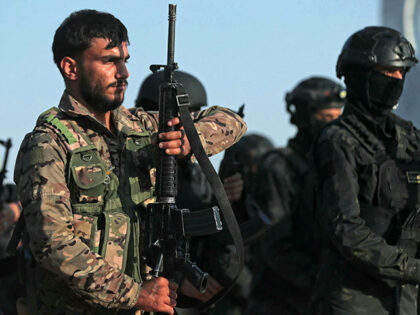
The Syrian Democratic Forces’ formal absorption into Damascus’s chain of command is more than a footnote in the post-ISIS Levant; it is a textbook case of how yesterday’s battlefield partners become tomorrow’s political liabilities once the common enemy is gone. The SDF’s American-supplied M4s, Mk 19s, and Javelin missiles—once the cutting edge of a decentralized, anti-caliphate coalition—are now assets of a unitary state whose new president, Ahmed al-Sharaa, has already signaled a preference for centralized control. For Second Amendment advocates watching from afar, the lesson is immediate: weapons and the skills to employ them are only as durable as the political settlement that ratifies their possession. When that settlement shifts, yesterday’s “allied militia” can be re-branded as tomorrow’s “unauthorized armed group,” and the rifles change hands without a shot being fired.
Equally instructive is the optics war now unfolding inside Syria’s borders. The same rifles that once flew the yellow SDF flag are being re-stocked under the tricolor of a Damascus government that, like most post-conflict regimes, will face pressure to monopolize force. That pressure is not abstract; it is the same impulse that historically drives registration schemes, “buy-back” edicts, and selective disarmament of minority communities. American gun owners who treat militia-integration stories as distant exotica miss the through-line: the moment a state decides that only its own forces may keep and bear arms, the definition of “legitimate” ownership narrows overnight. The SDF’s integration proves that even U.S.-vetted, combat-proven units are not immune once the maps are redrawn.
Finally, the episode underscores why dispersed, constitutionally protected ownership remains the ultimate hedge. A Kurdish fighter who laid down his issued carbine last week may discover that political winds shift again; an American who retains his own rifles under the Second Amendment does not need a new capital’s permission slip to remain armed. In a region where alliances pivot on the next Damascus cable, that distinction is not theoretical—it is the difference between a militia that can be ordered to stand down and a citizenry that cannot.


