

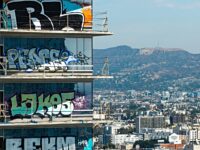
Los Angeles Mayor Karen Bass’s long-running experiment in “compassionate governance” has produced yet another monument to policy failure: the so-called Graffiti Towers, a pair of downtown high-rises whose ground-floor retail spaces have been reduced to open-air canvases for taggers and encampments. After months of complaints from nearby businesses and residents, crews are finally being dispatched to power-wash the walls and board up the broken windows—yet the underlying conditions that turned prime real estate into a magnet for crime remain untouched. For Second Amendment advocates, the episode is a textbook illustration of what happens when elected officials prioritize optics over enforcement: when police are told to stand down and prosecutors treat property crime as a social-justice footnote, the predictable result is an environment where lawful gun owners must be ever more prepared to defend themselves because the state has effectively abdicated that duty.
The cleanup itself is less a policy reversal than a pre-election photo-op; Bass’s administration still resists calls to restore meaningful policing or to green-light concealed-carry reciprocity that would let responsible Angelenos protect themselves in the very corridors city hall has surrendered. Meanwhile, California’s byzantine permitting process and its new “sensitive places” map keep turning downtown into a patchwork of gun-free zones surrounded by streets where open drug use and smash-and-grab crews operate with impunity. The lesson for the 2A community is straightforward: every boarded-up storefront is an argument for shall-issue carry, for constitutional carry on a statewide basis, and for the repeal of the state’s one-gun-a-month rule that disarms law-abiding citizens while leaving criminals untouched.
If Bass and the Sacramento supermajority truly wanted to make downtown safe again, they would start by enforcing existing laws against vandalism, theft, and illegal camping instead of waiting for the next ribbon-cutting ceremony. Until that happens, the Graffiti Towers will serve as a daily reminder that the right to keep and bear arms isn’t a theoretical talking point—it’s the practical backstop when progressive governance fails to secure the public square.


