

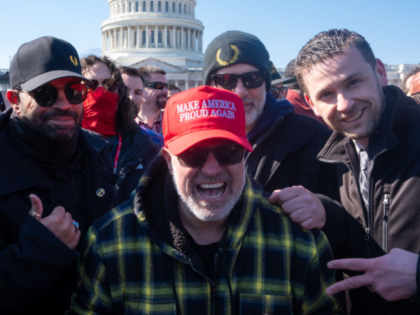
A federal judge appointed by President Trump has cleared the way to dismiss the convictions of four Proud Boys tied to the January 6 Capitol events, a move that instantly reignites the long-running debate over selective prosecution and the weaponization of federal power. For the 2A community, the ruling is more than a headline—it is fresh evidence that the same legal machinery used to label and punish political dissent can just as easily be turned on gun owners who refuse to surrender their rights. When prosecutors stretch statutes, stack charges, and rely on sympathetic judges to secure convictions, the precedent does not stay confined to one political faction; it becomes a template that future administrations can apply to anyone who owns an AR-15, carries a concealed firearm, or simply refuses to comply with the next round of “common-sense” restrictions.
The timing is especially telling. While the Proud Boys case winds down, the Biden-Harris DOJ continues to push aggressive interpretations of existing gun laws and to float new rules that would criminalize millions of otherwise law-abiding citizens. The contrast is stark: one side receives judicial relief after years of litigation, while the other side faces ever-expanding regulatory minefields backed by the same federal apparatus. This asymmetry should alarm every gun owner who has watched the ATF rewrite pistol-brace rules, redefine “engaged in the business,” or threaten FFLs with license revocation for paperwork errors. If courts can later unwind politically motivated convictions, they can also unwind politically motivated gun-control prosecutions—provided the judiciary remains willing to check executive overreach.
For the 2A community, the lesson is clear: legal victories are never permanent, and the only reliable defense is sustained political and cultural pressure that keeps the administrative state in check. Every time a judge reins in prosecutorial excess, it buys breathing room for the next fight over magazine bans, red-flag laws, or universal background checks. The Proud Boys dismissals are therefore not an isolated win for one group; they are a reminder that the same constitutional guardrails protecting political speech and assembly also protect the individual right to keep and bear arms. The moment gun owners treat these rulings as someone else’s problem is the moment the administrative state regains the momentum it needs to finish the job it started.


