

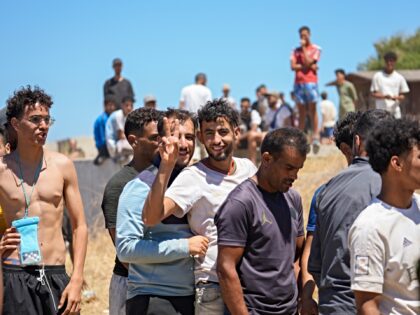
Italian intelligence has flagged a “concrete” terror risk in Ceuta after a sudden surge of illegal migrants overwhelmed the Spanish enclave’s border, and the warning lands like a live round chambered in a city already surrounded by hostile territory. Ceuta sits on the African side of the Strait of Gibraltar, a NATO-adjacent outpost whose 30-kilometer perimeter is the EU’s only land frontier with the Maghreb; when that line buckles, the first casualties are not abstract “values” but the ability of ordinary citizens to move, trade, and—yes—defend themselves without waiting for distant capitals to authorize a response. The Italian dossier reportedly links the influx to networks already on European watch-lists, meaning the same porous entry points that funnel economic migrants can just as easily deliver operatives trained in Libya or the Sahel—operatives whose preferred soft targets have repeatedly included crowded public spaces where lawfully armed civilians are either banned or disarmed by policy.
For the 2A community the lesson is not theoretical. Every time a Western jurisdiction treats self-defense as a privilege instead of a right, it creates exactly the kind of unarmed, high-value target set that jihadist planners exploit. Spain’s strict carry laws leave Ceuta’s residents dependent on a Guardia Civil garrison that can be stretched thin by simultaneous riots at multiple fence points; contrast that with the American model of shall-issue permitting and constitutional carry, where an attempted mass-casualty event can be met with immediate, distributed resistance rather than a delayed 9-1-1 call. The Italian alert also underscores a broader pattern: migration surges are rarely random, and governments that prioritize optics over vetting import both the foot soldiers and the ideological payload of groups that view the West’s gun-control zones as operational gifts.
The practical takeaway is straightforward—policy that severs the link between citizenship and effective self-defense does not reduce danger; it merely concentrates it on the law-abiding. As Ceuta’s experience shows, when the perimeter fails, the only variable left is whether the people inside that perimeter still possess both the legal right and the practical means to protect their own lives.


