

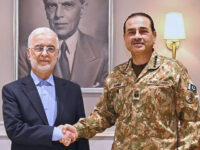
The renewed flare-up between Iran and its adversaries has now stretched into its tenth day, and the sight of Tehran’s emissary huddling with Pakistani mediators in Islamabad is more than diplomatic theater—it is a reminder that every regional crisis eventually circles back to the question of who can actually defend themselves when the shooting starts. Pakistan’s role as go-between is no accident; its porous western border with Iran has long been a corridor for both refugees and weapons, and any cooling-off arrangement will hinge on whether Islamabad can credibly guarantee that neither side’s proxies turn the frontier into another proxy battlefield. For Americans watching from afar, the takeaway is blunt: when statesmen fail to keep the peace, the only reliable backstop is an armed citizenry that refuses to outsource its security to distant capitals or faltering alliances.
That same principle scales directly to the domestic arena. While diplomats trade talking points, Iranian state media continues to trumpet the regime’s missile and drone programs as proof that only centralized power can deter aggression—an argument that conveniently ignores how those same systems have repeatedly failed to protect ordinary Iranians from internal crackdowns or external strikes. In contrast, the American model of distributed firepower, protected by the Second Amendment, has repeatedly shown that an armed population can deter both foreign mischief and domestic tyranny without waiting for a mediator’s phone call. The current standoff should therefore serve as a live-fire demonstration: nations that disarm their people in the name of “stability” often discover that stability evaporates the moment the mediators pack their bags.
For the 2A community, the lesson is not merely philosophical; it is practical. Every new sanctions regime, every fresh round of saber-rattling, drives up global demand for small arms, optics, and training—markets that American manufacturers and private citizens still dominate precisely because our constitutional framework treats the right to bear arms as non-negotiable infrastructure rather than a revocable privilege. If the Islamabad talks collapse, expect another surge in component prices and lead times; if they succeed, the underlying lesson remains unchanged. Peace is most durable where the people, not the palaces, hold the decisive firepower.


