

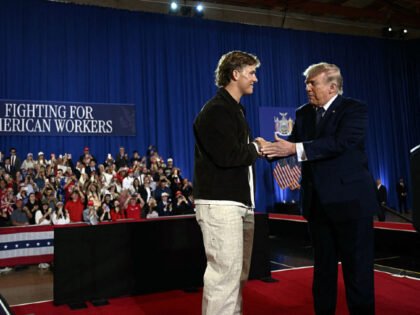
In the hyper-partisan pressure cooker that is today’s NFL locker room, Giants quarterback Jaxson Dart’s decision to introduce President Trump at a New York event has drawn fire from teammate Abdul Carter, who dismissed the moment as something that “looked like AI.” What Carter may have intended as a quick social-media jab actually spotlights a deeper cultural rift: an entire generation of athletes raised on curated outrage now treating open support for a pro-Second-Amendment president as either fake news or career suicide. Dart’s willingness to stand beside a man who restored federal recognition of the right to keep and bear arms, expanded carry reciprocity discussions, and appointed originalist judges who struck down magazine bans and “assault-weapon” restrictions, stands in sharp contrast to teammates who apparently view such alignment as digital deep-fake territory.
For the 2A community, the episode is less about football and more about the Overton window inside professional sports. When a young signal-caller publicly aligns with the candidate who delivered constitutional-carry momentum in dozens of states and blocked the last round of Biden-era pistol-brace and brace-rule attacks, it signals that the league’s once-monolithic progressive culture is developing hairline cracks. Carter’s incredulity reveals how thoroughly some players have internalized the notion that any public nod to Trump—or, by extension, to the natural right protected by the Second Amendment—is so outside the norm that it must be computer-generated. That perception matters when league offices, sponsors, and media partners still treat pro-2A statements as radioactive; every visible exception, even from a rookie quarterback, widens the lane for future athletes who refuse to outsource their gun rights to league-approved talking points.
The larger implication is that cultural enforcement, not statute, remains the biggest practical threat to the right to keep and bear arms inside elite institutions. If enough players follow Dart’s example and treat the Second Amendment as a first-principle rather than a partisan prop, the league’s internal speech codes will face the same market and fan backlash already reshaping other sectors. Until then, every unapologetic introduction of a pro-2A president by an NFL quarterback is another data point proving that the cultural fight over our constitutional freedoms is still very much being played out—on the field, in the locker room, and, yes, even at political rallies in New York.


