

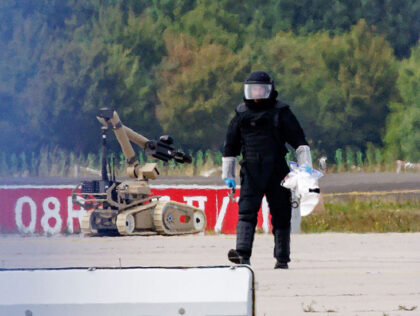
The drone that buzzed Leipzig/Halle Airport wasn’t some hobbyist quadcopter with a GoPro; German authorities say it carried a shaped-charge warhead and was deliberately flown into the path of a cargo jet that had just lifted off. Moments later the same aircraft—reportedly an Airbus A321 freighter—suffered what investigators are calling a “mid-air collision,” though radar tracks and cockpit voice recordings suggest the drone struck first and the jet’s subsequent deviation may have been an evasive maneuver rather than a second, unrelated impact. The timing is no coincidence: the incident unfolded within hours of heightened security alerts tied to Eastern European cargo routes, and the drone’s guidance package reportedly included commercial off-the-shelf GPS and inertial components that any competent hobbyist could source in Europe or the United States.
For the 2A community the takeaway is blunt: the same regulatory reflex that treats every rifle as a presumptive threat is already being aimed at civilian drones and the components that power them. European aviation officials are floating “geofencing mandates” and remote-ID backdoors that would let governments track or disable any aircraft the size of a Thanksgiving turkey. Those proposals mirror the logic once used against pistol grips and telescoping stocks—namely, that a lawful object becomes contraband the moment someone misuses it. American owners who shrugged off similar rules for unmanned aircraft may soon discover that magazine-capacity limits have a digital cousin: software locks that brick a drone the instant it strays into a no-fly polygon drawn by bureaucrats.
The deeper irony is that defensive tools already exist and are largely unregulated on U.S. soil. Shotgun-mounted nets, low-power directed-energy emitters, and good old-fashioned marksmanship remain legal in most states precisely because they target the malicious use, not the hardware itself. If the Leipzig incident proves that small armed drones are the next asymmetric threat, the right response is to harden soft targets and preserve the individual right to neutralise them—not to hand transport ministries a kill-switch for every aircraft that weighs more than 250 grams. The skies are about to become another contested domain; the question is whether the 2A community will defend access to the tools that let private citizens help secure them.


