

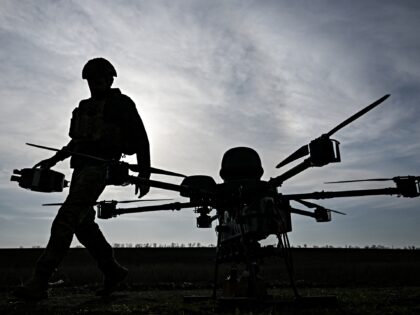
The European Union’s decision to bankroll joint drone production with Ukraine isn’t just another wartime procurement story—it’s a live demonstration of how quickly governments can scale autonomous lethal systems when political will and money align. By embedding EU factories inside Ukraine’s defense ecosystem, Brussels is effectively creating a distributed, NATO-adjacent arsenal that can churn out attritable munitions faster than any single member state’s bureaucracy would allow. For Second Amendment advocates watching from across the Atlantic, the lesson is unmistakable: when a conflict turns into a drone war of attrition, the side that can legally and rapidly produce small, cheap, lethal aircraft wins; the side that treats every firearm or component as a potential regulatory crisis loses.
That same dynamic should sharpen the domestic debate over civilian access to advanced small unmanned aerial systems. While European capitals green-light mass production of FPV and loitering munitions for Kyiv, many U.S. states and agencies are already floating registration schemes, geofencing mandates, and “sensitive location” flight bans that would cripple any comparable civilian or militia capability here at home. The Ukrainian battlefield is proving that real-time targeting, swarm coordination, and rapid field modification are force multipliers that no amount of legacy crew-served weapons can fully replace. If American gun owners accept the premise that an armed citizenry must remain relevant against state-level threats, then the right to keep, bear, and innovate with drones is no longer a hobbyist sideline—it is the logical extension of the same individual-right logic that protects semiautomatic rifles and optics today.
The deeper implication is strategic: Europe is learning in real time that sovereignty in the drone age belongs to those who can build, not merely buy, these systems. The United States still enjoys a large lead in component supply chains and software talent, but that advantage erodes every time a new layer of federal or state restriction is added under the banner of “public safety.” The 2A community’s task is to ensure that the same legal architecture that safeguards the right to a modern rifle also protects the right to a modern unmanned aircraft—before the regulatory asymmetry between Europe’s wartime urgency and America’s peacetime caution leaves U.S. citizens on the wrong side of the next technological inflection point.


