

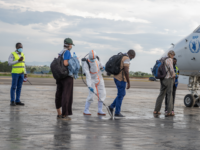
The Democratic Republic of Congo’s pushback against Ebola-related travel bans is a textbook case of how governments weaponize public-health emergencies to restrict movement and, by extension, the tools people might need to protect themselves when official systems collapse. Kinshasa calls the restrictions discriminatory, but the deeper issue is that once a crisis is declared, borders snap shut, supply lines freeze, and citizens are left to fend for themselves—often without the legal means to do so. For the 2A community this is a familiar pattern: the same logic that justifies disarming travelers “for safety” during an outbreak is the logic that justifies red-flag laws, magazine bans, and “sensitive place” prohibitions whenever officials decide the public is too frightened to notice the erosion of rights.
History shows that disease-driven mobility controls rarely stay narrowly tailored; they metastasize into broader surveillance and disarmament regimes. During past Ebola spikes, checkpoints in West Africa quickly became venues for arbitrary confiscation of property, including firearms, under the guise of “order maintenance.” In the U.S., the COVID-era rush to label gun stores non-essential proved how quickly a health pretext can be repurposed to throttle the right to keep and bear arms. Congo’s complaint therefore isn’t just about airline routes—it’s a warning that any government comfortable declaring an entire population a bio-risk is equally comfortable declaring that same population too dangerous to remain armed.
The takeaway for American gun owners is straightforward: every new category of emergency—pandemic, climate, cyber—expands the precedent for treating constitutional rights as optional. The 2A community’s job is to treat these foreign travel fights as domestic early-warning systems, pushing back against the idea that fear ever justifies prior restraint on the individual right of self-defense. When the next “discriminatory” restriction is proposed at home, the response should already be drilled: rights are not suspended by epidemiology, and an unarmed population is the real public-health crisis.


