

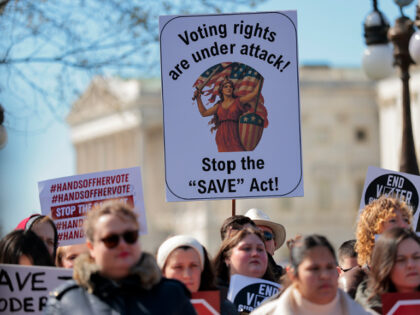
Democrats’ reflexive dismissal of the SAVE America Act as “trash” reveals far more about their priorities than any procedural objection. When the President laid out hard numbers—over 25 percent of non-citizens on some voter rolls, foreign actors harvesting data, and documented attempts to manufacture ballots—the response wasn’t a counter-investigation or tighter safeguards; it was an immediate pivot to protecting the very loopholes that make those vulnerabilities possible. For the 2A community this is a familiar pattern: the same political class that insists only government can be trusted with ballots is the one that simultaneously claims only government can be trusted with firearms. Both positions rest on the premise that citizens cannot be relied upon to safeguard their own sovereignty, whether at the ballot box or in the gun safe.
The deeper implication is structural. Election integrity and the right to keep and bear arms are not separate issues; they are two fronts in the same contest over whether ultimate authority resides with the people or with administrative gatekeepers. If non-citizens and foreign actors can tilt outcomes without consequence, then every subsequent policy—including red-flag laws, magazine bans, and registration schemes—rests on a corrupted mandate. Conversely, when citizens insist on verifiable citizenship, paper trails, and same-day in-person voting, they are also reinforcing the cultural habit of self-reliance that underpins support for constitutional carry and shall-issue permitting. The SAVE America Act is therefore not merely an election bill; it is a referendum on whether the Second Amendment remains anchored in a functioning republic or becomes a paper right exercised at the sufferance of whoever controls the voter file.
What the left’s trash-bin rhetoric inadvertently confirms is that meaningful reform threatens an ecosystem built on opacity. The 2A community has watched this movie before: every time background-check databases are expanded without corresponding fixes to illegal-immigrant voting or deceased-voter maintenance, the asymmetry grows. Citizens who can prove they are citizens and vote in person are far harder to marginalize than those whose eligibility is treated as an administrative assumption. Securing elections is therefore not a distraction from gun rights; it is the predicate that keeps the Bill of Rights from being renegotiated every two years by whichever faction happens to control the machinery of counting.


