

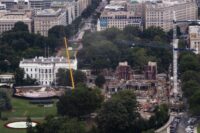
The appeals court decision forcing President Trump to seek congressional approval before completing the White House ballroom is more than a procedural hiccup—it’s a textbook example of how the administrative state weaponizes process to constrain executive action. By halting construction on what is, at its core, a private renovation funded by private donors, the ruling underscores the growing tendency of federal courts to treat even the most mundane presidential decisions as subject to endless litigation. For Second Amendment advocates, this is a familiar pattern: the same legal machinery that can stall a ballroom renovation is routinely deployed to delay or derail pro-2A executive orders, ATF rule changes, or nominations to the federal bench. When every administrative step becomes a potential lawsuit, the ability of a pro-Second Amendment administration to deliver swift policy victories shrinks dramatically.
What makes the ballroom case especially instructive is the court’s willingness to insert itself into what has historically been considered the president’s personal discretion over White House facilities. If a three-judge panel can order a halt to interior construction on separation-of-powers grounds, it’s not hard to imagine similar logic being used to challenge future ATF personnel changes, the composition of the NSSF advisory board, or even the administration’s ability to direct enforcement priorities away from FFL compliance sweeps. The precedent isn’t just about ballrooms; it’s about whether the executive branch can act decisively on any issue without first running a bureaucratic and judicial gauntlet designed by its political opponents.
For the 2A community, the takeaway is clear: procedural victories in court are only as durable as the political will to defend them. While the ballroom ruling may seem trivial, it signals that institutional resistance to Trump 2.0 will be fought in the weeds of administrative law rather than on the Senate floor. Gun owners who want to see suppressed SBRs, deregulated pistol braces, and an end to the pistol brace rule should recognize that every procedural barrier erected against the president is another obstacle between them and policy implementation. The fight over a ballroom is a dress rehearsal for the far more consequential battles over who gets to define the regulatory landscape of the Second Amendment.


