

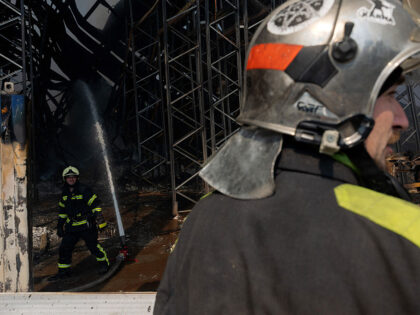
The strike on Wildberries’ sprawling fulfillment center in the Urals is more than another headline in a distant war; it is a textbook demonstration of how precision-guided, long-range unmanned systems can reach deep into a nation’s industrial and commercial heartland. Ukrainian forces have shown that a handful of drones—each carrying a modest warhead—can shut down a facility that moves millions of parcels a day, forcing Moscow to divert air-defense assets hundreds of miles from the front. For the Second Amendment community, the lesson is immediate: the same technologies that allow a weaker state to impose costs on a stronger one are already available, in civilian-legal form, to private citizens in the United States. Hobby-grade FPV drones, off-the-shelf autopilots, and open-source flight software are today’s equivalent of the “common militia arms” the Founders expected citizens to keep.
What matters for gun owners is not the drones themselves, but the principle that technology diffusion favors the distributed, armed populace over centralized power. Just as the AR-15 and the 3-D-printed lower receiver leveled the practical disparity between a citizen and a SWAT team, affordable long-range UAS kits are narrowing the gap between a state’s conventional forces and an informed, equipped citizenry. The Russian experience also underscores why magazine bans, “assault-weapon” restrictions, and proposed drone-registration schemes are strategically shortsighted: they attempt to freeze a weapons technology at a single point in its development curve, exactly when rapid, decentralized innovation is accelerating.
Finally, the raid illustrates the deterrent value of an armed society that can field its own unmanned systems. A nation whose citizens already own millions of drones, precision rifles, and encrypted communications networks presents a far more complicated target set than one that relies solely on uniformed forces. The Ukrainian strike did not defeat the Russian army; it reminded Russian leadership that modern war can be brought home to warehouses, rail yards, and power substations. That reminder is worth more to the 2A community than any press release from Washington.


