

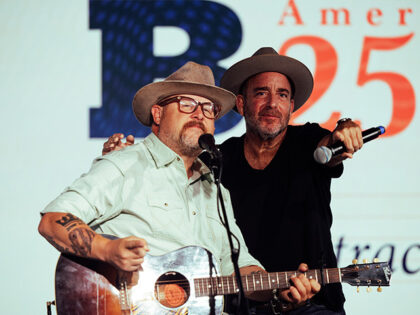
In a cultural moment where the American experiment is being stress-tested from every direction, the collaboration between Nashville hitmaker Michael Farren and singer Jon Kahn on “United Saints of America” feels less like another patriotic single and more like a deliberate act of cultural reclamation. Farren’s track record of crafting songs that resonate across the heartland pairs with Kahn’s proven ability to turn political conviction into anthemic sound—most notably with the Trump-era “Fighter.” Together they’re not just writing about unity; they’re modeling it by refusing to let coastal tastemakers own the narrative of what it means to love this country in 2026. For the 2A community, the timing matters: as the nation approaches its semiquincentennial, the song arrives as a reminder that the right to keep and bear arms isn’t an asterisk on American identity but part of the same continuum of self-reliance, ordered liberty, and unapologetic independence the lyrics appear to celebrate.
The deeper implication is that Second Amendment advocates have long understood culture as the upstream battleground—laws can be challenged in court, but hearts and minds are shaped in studios, on stages, and through streaming playlists. When songwriters of Farren’s caliber step into explicitly patriotic territory, they expand the Overton window for what counts as mainstream rather than fringe. That matters when legacy media still frames gun owners as outliers; hearing the same values expressed in three-minute country-radio form quietly normalizes the idea that an armed citizenry is compatible with, even essential to, a functioning republic. The Breitbart initiative itself underscores this shift: instead of waiting for Hollywood or Nashville’s old guard to bless pro-liberty themes, outlets and artists are building parallel pipelines that reach millions without apology or translation.
Ultimately, “United Saints of America” functions as both art and soft power. It gives the 2A community another cultural artifact to share at ranges, family gatherings, and online spaces where younger gun owners are forming their political identities. More importantly, it signals that the defense of the Second Amendment will not be won by legislation alone; it will be secured when the stories Americans tell about themselves once again include the armed citizen as protagonist rather than problem. In that sense, Farren and Kahn aren’t just releasing a song—they’re reinforcing the cultural infrastructure that makes constitutional carry feel not like a policy debate but like common sense.


