

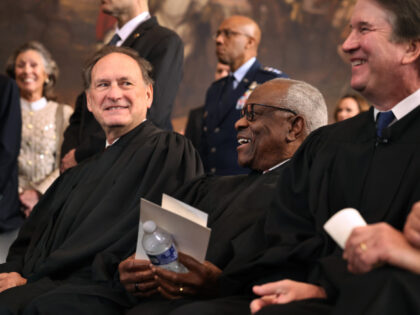
Justice Samuel Alito’s blunt declaration that he’s “here for another term” is more than a personal career note—it’s a strategic signal to the entire federal judiciary and the political class that the Court’s 6-3 conservative majority isn’t going anywhere soon. By publicly snuffing out retirement chatter, Alito removes any leverage the left might have hoped to gain by dangling a Biden-era vacancy in front of Senate Democrats. For the Second Amendment community, that matters: Alito has been the Court’s most consistent textualist on the right to keep and bear arms, from his stinging McDonald concurrence to his willingness in Bruen to treat the plain text of the Second Amendment as the starting point rather than an afterthought. A sudden vacancy would have invited a bruising confirmation fight that could have peeled off one or more Republican senators and risked a nominee more timid on the right to arms.
The timing is equally telling. With the 2024 election cycle heating up, Alito’s statement effectively freezes the Court’s composition through at least the next presidential term. That stability gives lower-court judges—many of whom are still sorting out the post-Bruen landscape—clearer guidance that the textual, history-and-tradition test is not a passing fad. It also discourages opportunistic litigation by gun-control groups hoping to exploit a short-handed bench. In practical terms, expect continued pressure on assault-weapon bans, magazine restrictions, and “sensitive places” doctrines; judges who might have hedged their bets now have less reason to wait for a possible liberal replacement.
For 2A advocates, the takeaway is straightforward: the jurisprudential battlefield just got a little more predictable. Alito’s resolve shores up the originalist flank at a moment when several pivotal cases—on the constitutionality of pistol braces, state-level carry restrictions, and the ever-expanding list of prohibited persons—are queued for review. Rather than a retirement drama, the Court is signaling business as usual, and that continuity is itself a quiet but potent victory for the right to keep and bear arms.


